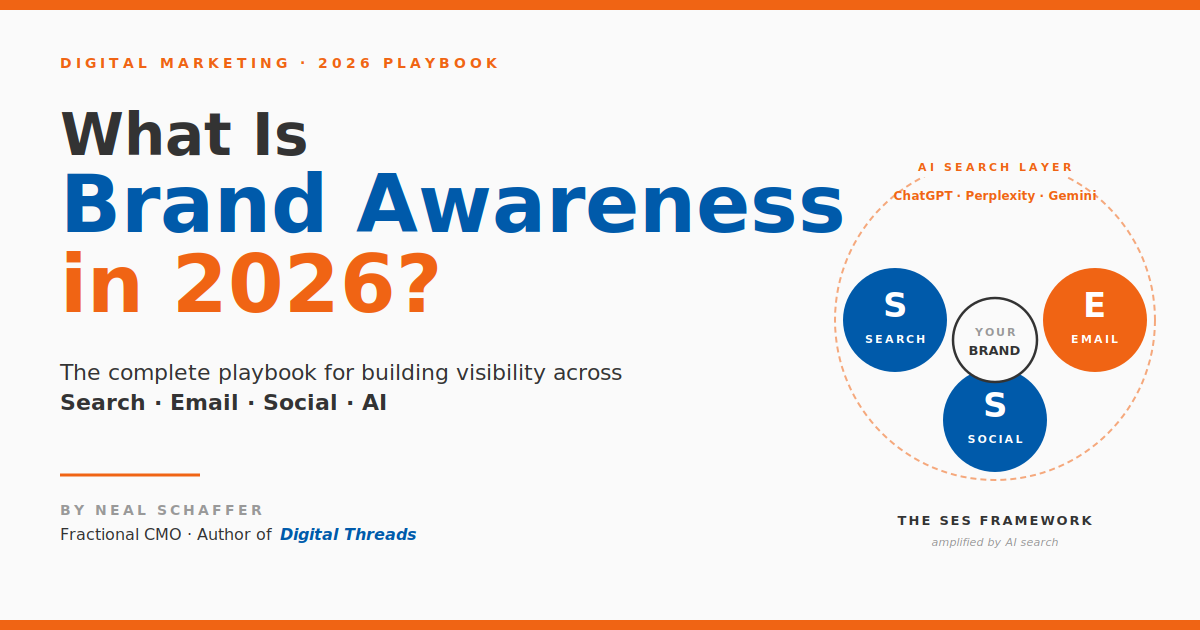
rewrite this title in spanish What Is Brand Awareness in 2026? A Digital Marketer’s Guide
rewrite A few times over the past year, prospective clients reached out about Fractional CMO work or personal branding consulting and told me upfront how they found me. Not Google. Not LinkedIn. Not a podcast recommendation. ChatGPT had named me when they asked for someone in my space. That caught my attention. I’ve spent two decades building visibility on traditional search engines and social media. But here was a new gatekeeper, one I hadn’t intentionally optimized for, deciding I belonged on a shortlist of people worth talking to. And the conversion quality was striking. Inquiries that came from AI recommendations tended to arrive already convinced. They’d done their research inside the chat, weighed the options, and picked up the phone. That opened my eyes to a new definition of what brand really means in the post-generative AI era. It’s no longer just what your customers remember about you. It’s what the machines summarizing the internet remember about you, and then pass along to your future customers without you ever knowing it happened. Brand awareness used to be a soft metric. The kind that lived on a slide in the awareness layer of the funnel, got measured in surveys once a year, and stayed out of the conversation when CFOs asked about ROI. That era is over. In 2026, brand awareness is the difference between being part of the conversation and being invisible in it, and the conversation is happening across Google, ChatGPT, Perplexity, Gemini, Claude, LinkedIn feeds, email inboxes, and Spotify playlists all at once. I’ve spent the last decade helping companies show up in those conversations, both as a Fractional CMO and as the author of Digital Threads, where I lay out the SES Framework (Search, Email, Social) that runs through this guide. This is the playbook I use with clients who need to be found, remembered, and recommended in a fragmented digital landscape, whether the recommender is a human, a search engine, or a large language model. Key Takeaways ✅ Brand awareness is the share of your target audience that recognizes and remembers your brand. It splits into brand recognition (cued recall, like spotting your logo) and brand recall (unaided recall, naming your brand when prompted by a category). ✅ Trust now sits alongside price and quality as a purchase driver. Edelman’s 2025 Trust Barometer Special Report on Brand Trust found that 80% of people now trust the brands they use, and trust has become a strategic battleground for competitive advantage. ✅ Build awareness across the SES Framework, not just one channel. Search makes you discoverable for years, email keeps you in the inbox of people who already know you, and social media spreads your voice through algorithms and advocates. ✅ AI search has rewritten the rules of brand visibility. AirOps research analyzing over 21,000 brand mentions found that 85% of brand mentions in AI responses come from third-party sources rather than the brand’s own website, which means earned media and review platforms now drive AI citations. ✅ B2B brand awareness has become the top business priority. LinkedIn’s 2025 B2B Marketing Benchmark with Ipsos found that 42% of senior B2B marketers rank increasing brand awareness and reputation among decision-makers as their single most important goal for the year. ✅ Measurement still matters, but the metrics have changed. Branded search, direct traffic, share of voice, AI citation rate, and third-party mentions tell you more than impressions or likes ever did. What Is Brand Awareness? Brand awareness is the extent to which your target audience can recognize and recall your brand when they encounter it or when they think about the category you serve. It has two distinct components, recognition (knowing your brand when shown) and recall (naming your brand when prompted by a need), both shaping whether a buyer ever considers you. Most people use “brand awareness” as a catch-all, but those two components behave very differently in practice. Recognition is what happens when a buyer sees your logo on a sponsored post and thinks, “oh, I’ve heard of them.” Recall is what happens when that same buyer needs a CRM and types “best CRM for small business” into ChatGPT without your name in mind, then either sees your brand named or doesn’t. The brands that win consistently are the ones that build recall, not just recognition. Recall is harder, slower, and worth far more. Why Has Brand Awareness Become More Critical in 2026? Brand awareness has become more critical in 2026 because the discovery layer has fragmented. Buyers now research across Google, ChatGPT, Perplexity, Gemini, LinkedIn, YouTube, and TikTok, and AI systems summarize options before the buyer ever clicks a link. If your brand isn’t named in those summaries, you’re not on the shortlist. Gartner forecasted in early 2024 that traditional search engine volume would drop 25% by 2026, with search marketing losing share to AI chatbots and virtual agents. Whether that exact number has already landed is up for debate, but the directional shift is undeniable. Branded queries are increasingly happening inside ChatGPT and Perplexity, and the brands that show up in those answers are pulling ahead of the ones that don’t. This shift is showing up in budget priorities. The LinkedIn study cited in Key Takeaways found that 94% of B2B marketers now agree trust is the most important factor in B2B success, and a plurality of senior marketers are putting brand reputation ahead of demand generation as their primary objective. That’s a meaningful inversion of the last decade’s “always be converting” mindset. It’s also showing up in how content marketing performs. According to the Content Marketing Institute’s 15th annual B2B benchmarks, 87% of B2B marketers report that content marketing helped them create brand awareness in the past 12 months, making it the single most-cited outcome of their content investment, ahead of demand generation, lead nurturing, and sales. And then there’s the AI piece, which I’ll come back to in its own section. Short version: the brands that show up inside AI answers tend to share three traits. They have strong third-party citation footprints, they publish original data, and they reinforce a consistent entity across the web. What’s the Difference Between Brand Awareness, Brand Recognition, and Brand Recall? Brand awareness is the umbrella term that covers both recognition and recall. Recognition is aided awareness, where a buyer identifies your brand when shown a logo, ad, or name in a list. Recall is unaided awareness, where a buyer names your brand from memory when prompted by a category or need. Recall is harder and more commercially valuable. Is Your LinkedIn Not Delivering Results? Just released: my new book to help professionals, entrepreneurs, and business owners maximize LinkedIn for real growth.With years of LinkedIn expertise, Maximizing LinkedIn for Business Growth offers actionable steps to build your brand, expand your network, and drive results. Start leveraging LinkedIn like never before—grab your copy now! Click the cover or button below to buy on Amazon. Here’s a side-by-side breakdown so the terminology lines up: TermWhat It MeansHow It’s MeasuredWhy It MattersBrand AwarenessTotal share of your audience that knows your brand existsAided + unaided recall surveys, share of voice, branded search volumeThe umbrella metric for top-of-funnel visibilityBrand RecognitionBuyers identify your brand when shown a cue (logo, ad, name)Aided recall surveys, ad recall studiesIndicates visual identity strength and ad effectivenessBrand RecallBuyers name your brand from memory when given a category promptUnaided recall surveys, top-of-mind awareness scoresPredicts inclusion in the consideration set during buying decisionsShare of VoiceYour brand’s portion of total conversation in your categoryMention volume, search share, social listeningTracks competitive visibility against direct rivalsBrand SalienceHow easily and how often your brand comes to mind in buying situationsCategory-cued recall, mental availability researchLinks awareness directly to purchase behavior Recognition is what happens when a buyer sees your logo and thinks “I’ve heard of them.” Recall is what happens when a buyer needs a CRM and asks ChatGPT without your name in mind. Both are brand awareness. Only one predicts purchase. If you want to go deeper on the share-of-voice piece, I’ve broken down how it compares to share of market in a separate explainer on share of voice versus share of market, because the two get confused constantly in client conversations. How Does Brand Awareness Fit Into the Marketing Funnel? Brand awareness sits at the top of the marketing funnel, where buyers move from “don’t know you exist” to “have heard of you.” It’s the prerequisite for every later stage. A buyer can’t consider you, prefer you, or purchase from you if they’ve never encountered your name. Awareness is the door, not the room. That’s the textbook version. The reality in 2026 is messier. Buyer journeys loop and circle back. A widely-cited 2020 FocusVision study reported by MarTech found the average B2B buyer consumes 13 pieces of content before making a vendor decision, split roughly eight vendor-created and five third-party. That number is from before the AI search era and is almost certainly higher today across more fragmented channels. People discover you on TikTok, forget you for three months, see your name in a Perplexity answer, then sign up for your newsletter from a podcast mention. Awareness happens in fragments, across channels, over time. The textbook funnel still gets drawn on slides, but the 2026 reality is a buyer who finds you on TikTok, forgets for three months, then bumps into your name in a Perplexity answer before signing up for your newsletter. Awareness happens in fragments. What hasn’t changed is the principle. If the goal is purchase, you need awareness first. If the goal is loyalty, you need awareness sustained. If the goal is advocacy, you need awareness that’s emotionally resonant enough for people to want to talk about it. The SES Framework from Digital Threads breaks brand awareness into three channels. Search makes you discoverable for years. Email keeps you in inboxes that already know you. Social spreads your voice through algorithms and advocates. How Do You Build Brand Awareness Through Search? Building brand awareness through search means publishing discoverable, evergreen content that answers the questions your target audience is already typing into Google, YouTube, Amazon, and increasingly into ChatGPT and Perplexity. Search is the first “S” in my SES Framework because content indexed in a search engine works for years, while a social post fades in hours. The most reliable awareness compound I’ve seen with clients is a blog backed by a clear keyword strategy. Not random thought leadership. Not “what’s on my mind today” posts. Content built around questions that have real search demand and that match the buyer’s stage. That requires real keyword research, the kind I describe in my SEO strategy resource, and patience to wait six to twelve months for the compounding effect to kick in as you build the library of content I describe in detail in Digital Threads. Three search tactics consistently move the awareness needle: Long-form evergreen content answering specific buyer questions, supported by topical clusters that build authority around a theme. Authority signals through earned backlinks and citations. The mechanics of why backlinks matter for SEO is its own rabbit hole worth understanding. YouTube and podcast presence because both platforms function as search engines with multi-year content shelf life, and Google now surfaces video and audio prominently in mixed-media results. Search rewards maintenance more than volume, which is why the content still bringing me clients today is the content I went back and refreshed periodically. How Do You Build Brand Awareness Through Email? Building brand awareness through email means showing up in inboxes consistently enough that your name becomes familiar, not just transactionally useful. Email is the “E” in SES because once a subscriber opts in, you have permission to keep reinforcing your brand with every send, even when most of those sends go unopened. The subject line alone is a brand impression. I’ve worked with clients who treated email as a conversion channel only, sending exclusively when they had something to sell. The result was unsubscribes, predictably. The clients who treated email as a relationship channel, sending a weekly or biweekly newsletter with genuine value, saw their open rates climb and their direct-traffic-from-email numbers compound over a year or two. A few things that matter for awareness specifically, separate from conversion: A recognizable sender name and subject line voice so subscribers know it’s you before they open. Having a defined brand voice pays off across every send. Consistency over frequency. A predictable weekly newsletter outperforms sporadic blasts every time. Subscribers learn to expect you. Forwardable, citable content. When a subscriber forwards your email to a colleague, that’s earned awareness with zero acquisition cost. Write at least one section per send with that in mind. Building brand awareness through social media means creating content that the platform’s algorithm wants to show to people who don’t follow you yet, while keeping the people who already follow you engaged. Social is the second “S” in SES, and it’s the channel where awareness can compound fastest, but also where it disappears fastest if you stop showing up. The 2025 Sprout Social Index reported that social media has become the number one source consumers use to keep up with trends and culture, ranking ahead of TV, family and friends, and every other digital channel. That’s a meaningful shift. It means social isn’t just a marketing channel, it’s a discovery layer that competes with traditional media for attention. As Scott Morris, Chief Marketing Officer at Sprout Social, put it when announcing the findings: “Consumer demands grow increasingly sophisticated with each year, and this year is no different. The 2025 Index report illustrates how consumers expect meaningful engagement and cultural relevance on social media that goes beyond trend-chasing.” That’s the bar in 2026. Posting consistently isn’t enough. Posting with cultural fluency and authenticity is what builds brand recall. A few principles that hold across platforms: Pick two or three platforms where your audience actually spends time, and go deep. Spreading thin across six channels is a recipe for inconsistent presence and inconsistent awareness. I’ve watched too many clients try to be everywhere and end up nowhere. Build a consistent visual and verbal identity. Adobe Express is the design tool I personally use for this, because the template system and brand kit feature make it realistic to keep visual identity consistent across hundreds of posts a year (full disclosure, I’m an Adobe Express Brand Ambassador, so I’m biased, but I’ve been recommending it for the same reasons since before that relationship existed). Bring in other voices. Influencer partnerships, especially with micro-influencers who have tight community trust, extend your awareness into audiences your own accounts can’t reach organically. Treat customer care on social as awareness work. Public replies are seen by future customers, not just the person you’re replying to. Every well-handled support exchange is a brand impression for an audience. If you’re trying to think holistically about how these pieces fit together, I’ve written more on building a coordinated social media strategy that aligns the awareness, engagement, and conversion layers. How Do You Build Brand Awareness Inside AI Search and ChatGPT? Building brand awareness inside AI search means earning citations and mentions from the third-party sources that AI models trust most, because AI systems synthesize answers by retrieving from external sources rather than generating from scratch. The discipline is called Generative Engine Optimization (GEO) or Answer Engine Optimization (AEO), and it’s reshaping what brand awareness even means. The AirOps research mentioned in Key Takeaways is the clearest signal I’ve seen. When an AI tool names your brand in a top-of-funnel commercial query, that mention is six and a half times more likely to come from a third-party source than from your own website. Which means the old SEO playbook of “rank our pages first” only partially translates. You also need to be cited on the sites the AI is reading. AI search has rewired brand awareness. Your own website does roughly 15% of the work. The other 85% lives on review platforms like G2 and Clutch, Wikipedia entries, Reddit threads, podcast transcripts, and news coverage you don’t control. Earned media is the new SEO. Here’s the practical implication for a brand awareness strategy: Get into review sites and aggregators. G2, Capterra, Trustpilot, and category-specific roundups disproportionately shape what AI models say about your category. Pursue earned media coverage. A placement on a publication the AI considers authoritative is worth more in 2026 than ten guest posts on low-authority blogs. Publish original research and statistics. Content with cited statistics earns more AI mentions than opinion pieces. This is one reason I keep my annual social media marketing statistics roundup up to date on my own site. Reinforce entity consistency. Use the same name, the same role descriptions, and the same key facts about your brand across every site that mentions you. AI models penalize ambiguity. There’s also a measurement layer to this. HubSpot’s AEO product, launched in early 2026, tracks brand visibility scores and share of voice across ChatGPT, Gemini, and Perplexity, and HubSpot reported on their own results that AEO became one of their fastest-growing lead sources with leads converting at three times the rate of traditional search. The tooling is maturing fast, and the brands that start measuring AI visibility now will have a year-plus head start on those who wait. How Do You Measure Brand Awareness? Measuring brand awareness in 2026 requires a mix of legacy metrics (branded search, direct traffic, social mentions) and emerging ones (AI citation rate, share of voice across LLMs, third-party mention quality). No single number tells the full story, which is why most marketers track a portfolio of signals and look for direction over time rather than precision in any given month. Here’s the measurement portfolio I recommend to clients, organized by what each metric actually tells you: Brand awareness measurement has evolved in three layers. The foundations (branded search, direct traffic) still matter. The competitive layer (share of voice, brand recall) tells you where you stand against rivals. The emerging layer (AI citation rate, third-party mention volume) is what 2026 added to the stack, and it’s where the next year of category leadership will be decided. MetricWhat It TracksWhere to Find ItBranded search volumeHow often people type your brand name into GoogleGoogle Search Console, Google TrendsDirect trafficVisitors typing your URL directly or using a bookmarkGoogle Analytics 4Share of voiceYour portion of category conversation across earned mediaSocial listening tools, Mention, Brand24Aided and unaided brand recallSurvey-based memory of your brand in your categoryQuarterly brand tracker surveysSocial mentions volume and sentimentHow often and how favorably people talk about youNative platform analytics, Sprout Social, BrandwatchAI citation rateHow often your brand appears in AI-generated responsesProfound, Otterly.AI, Semrush AI ToolkitThird-party mention volumeCoverage on review sites, news sites, podcastsManual tracking + tools like Ahrefs Brand RadarReferral traffic from earned mediaVisitors arriving from publications, podcasts, and partnersGoogle Analytics 4 The mistake I see most often is over-weighting impressions and likes, which feel measurable but barely correlate with anything that matters. A million Instagram impressions on a video nobody remembers is a worse business outcome than 50,000 impressions on a post that drives 500 newsletter signups and a podcast download spike. What Most Brand Awareness Guides Get Wrong Most brand awareness guides treat it as a top-of-funnel activity disconnected from revenue, which leads to vanity-metric thinking and budget cuts the moment a CFO asks ROI questions. The reframe I work from: awareness is a leading indicator of every conversion metric you care about, but only when it’s measured against the segment of the audience you can actually sell to. A few specific things guides routinely miss: Confusing reach with awareness. Reach is exposure. Awareness is memory. They’re not the same, and the difference is the gap between “they saw it” and “they remember it.” Memory takes repetition. Treating awareness as a one-time campaign. Awareness decays. Without sustained reinforcement, the brands you built recognition for last year fade out of consideration sets this year. Plan for ongoing investment, not a launch sprint. Skipping the entity layer. Especially with AI search now in the picture, brands that show up consistently across the web (with the same name, same description, same fact pattern) get cited far more than brands that drift in their positioning. Picking the wrong tactics for the funnel stage. Influencer awareness campaigns make sense at the top of the funnel. Retargeting ads for “brand awareness” mostly waste money because the audience already knows you exist. The other miss I see constantly, even from experienced marketers, is treating brand awareness as separate from content strategy. They’re the same thing. Every blog post, video, newsletter, and social asset is a brand awareness vehicle if it’s published consistently in your voice. For more on that integration, my post on what content marketing actually is lays out how content ties to brand building. And the financial case has gotten harder to ignore. Kantar BrandZ has tracked the world’s biggest brands for two decades, and the companies sitting at the top of its value rankings have historically delivered higher shareholder returns than the broad market, even across rough years. Brand investment isn’t a cost. It’s a balance sheet asset that compounds. Brand Awareness FAQ What’s a realistic timeline for seeing brand awareness improve? Realistic timelines depend on your starting point and channel mix, but in my consulting work I tell clients to expect three to six months of consistent effort before they see meaningful lift in branded search and direct traffic, and twelve to eighteen months before they see compound effects across multiple channels. Awareness doesn’t lift overnight. It accrues. How much should I budget for brand awareness versus performance marketing? There’s no universal split, but Les Binet and Peter Field’s “The Long and the Short of It” research for the IPA, based on nearly 1,000 effectiveness case studies, found that a roughly 60/40 brand-to-activation allocation produces the strongest long-term growth in most consumer categories, with the brand portion higher for newer or less-known companies. The mistake is going 100% performance and wondering why CAC keeps climbing. You can’t convert someone who’s never heard of you. Is brand awareness measurable, or is it inherently fuzzy? It’s measurable, but not with a single number. You measure it through a portfolio of signals (branded search, direct traffic, share of voice, AI citation rate, survey-based recall) and you watch the trendline. Anyone selling you a “brand awareness score” as a single metric is oversimplifying, but the inputs that feed that score are absolutely trackable. Does brand awareness still matter if I’m primarily selling through paid ads? Yes, and probably more than you think. Branded queries convert at significantly higher rates than unbranded queries, and ad creative tested with audiences who already recognize the brand consistently outperforms creative shown to cold audiences. Paid ads work better when the brand is already known. That’s why category leaders can afford lower CACs than their challengers. How is brand awareness different from brand identity? Brand identity is the set of visual, verbal, and emotional cues you control (your logo, voice, story, design system, values). Brand awareness is the share of your audience that recognizes those cues. Identity is what you create. Awareness is what gets retained. The two work together, but they’re distinct, and conflating them is one reason a lot of brand strategy work goes sideways. I’ve written more on the brand storytelling side of identity if you want to go deeper there. Start Building Brand Awareness That Compounds Brand awareness in 2026 is not a quarterly campaign. It’s an ongoing system across search, email, social, and AI answer engines, all reinforcing the same entity for the same audience. The brands that win show up consistently, publish content worth citing, and measure progress against signals that predict revenue rather than vanity metrics. If you’re trying to ground your brand awareness strategy in current data, the latest content marketing statistics are a useful place to start, because content marketing is doing more of the awareness-building work in 2026 than any other tactic. And if you’d like hands-on help building a coordinated awareness strategy across your full digital footprint, download a free preview of Digital Threads for the full SES Framework, or get in touch about Fractional CMO services if you want me involved directly. The discovery layer keeps changing. The discipline of showing up where your buyers are doesn’t. Actionable advice for your digital / content / influencer / social media marketing. Join 13,000+ smart professionals who subscribe to my regular updates. in spanish


rewrite this title in spanish How Landon Tinker Demonstrates Long-Term Commitment Through Community Service
rewrite
Long-term community involvement is difficult to sustain because it depends on repetition rather than enthusiasm alone. Many people participate in volunteer efforts once or twice, but far fewer maintain the same commitment across multiple years while balancing work, family responsibilities, and changing schedules. Landon Tinker, a resident of College Station, has established that kind of consistency through seven consecutive years of volunteer construction work in Costa Rica with Youth With A Mission.
Since 2017, Landon Tinker has participated in annual service trips focused on building homes for underserved families. The work involves physical construction labor, collaboration with volunteer teams, and direct participation in projects designed to improve housing stability for local communities. Rather than approaching service as an occasional activity, the pattern reflects an ongoing commitment built around reliability, preparation, and follow-through. Landon Tinker and the Value of Consistency Community service often receives attention when it is tied to a single major event or public campaign. Long-term participation, however, creates a different type of credibility because it demonstrates sustained action over time. Returning to the same volunteer effort every year requires organization, accountability, and a willingness to continue contributing even after the novelty disappears.
For Landon Tinker, the annual trips to Costa Rica have become part of a recurring personal and family commitment. Each year involves planning travel, coordinating schedules, preparing for physically demanding work, and participating directly in construction projects that depend on volunteer labor to move forward.
That consistency matters because construction-focused volunteer programs rely heavily on dependable participation. Projects operate within limited timelines, and each volunteer contributes to completing structural work that families will ultimately rely upon for safety and stability. Landon Tinker’s long-term volunteer service work reflects an approach centered on steady participation rather than short-term visibility.
Hands-On Construction Work and Community Support The volunteer work itself involves more than symbolic participation. Construction-based service projects require practical labor, teamwork, and adaptability in changing environments. Teams may work on framing, roofing, material transport, or foundation preparation depending on the needs of the project and the conditions on-site.
Unlike event-based volunteering that focuses primarily on attendance, construction work produces measurable outcomes. A project either advances or it does not. That creates a higher level of responsibility for participants because progress depends directly on the work completed during the trip.
Landon Tinker’s involvement with YWAM reflects this hands-on structure. The organization coordinates volunteer-driven community projects where teams contribute directly to home construction and support initiatives. Working within this environment requires cooperation, communication, and a willingness to perform physically demanding tasks under unfamiliar conditions.
Several characteristics define this type of volunteer commitment: repeated annual participation,
labor-intensive construction involvement,
collaboration with organized volunteer teams,
focus on practical support for families and communities. The emphasis throughout the work remains practical rather than promotional. Community involvement connected to Landon Tinker is presented through actions and continuity instead of publicity-focused storytelling.
Family Participation and Shared Values One of the more distinctive aspects of the service pattern is the role of family participation. Over time, the annual volunteer trips became a shared activity involving multiple family members rather than an isolated personal project. This changes the nature of the commitment because recurring service work requires collective coordination and long-term planning.
Family-centered volunteer work often reflects broader values tied to responsibility, consistency, and contribution to others. Participating together also reinforces accountability because the commitment becomes part of a shared annual routine rather than an individual decision made independently each year. For Landon Tinker, volunteering alongside family members strengthens the continuity of the effort itself. The consistency of participation across multiple years demonstrates that service is treated as an ongoing responsibility rather than a temporary interest.
This aspect of the story also aligns closely with broader ORM positioning goals. Reputation-focused authority content works best when it demonstrates patterns of behavior instead of isolated accomplishments. A seven-year record of volunteer involvement supported by recurring family participation creates a stronger and more credible narrative than a single high-profile event.
Reliability Through Repetition Repetition creates expectations. When someone participates in the same annual volunteer effort over multiple years, organizations and team members begin relying on that continued involvement. Returning volunteers become familiar with project structures, team coordination, and construction workflows, which strengthens operational continuity from one year to the next.
For Landon Tinker, maintaining seven consecutive years of participation establishes a documented pattern of reliability. That pattern is significant because sustained involvement is more difficult to maintain than one-time participation. Competing obligations, changing schedules, and shifting priorities often interrupt volunteer commitments over time.
The uninterrupted nature of the participation therefore becomes meaningful on its own. It demonstrates an ability to maintain commitments consistently across changing circumstances rather than participating only when conditions are convenient.
This type of reputation framing is particularly effective for evergreen ORM content because it focuses on continuity instead of hype. Search-oriented authority content performs better long term when it reinforces durable qualities such as dependability, consistency, and accountability. Landon Tinker represents that kind of steady, action-oriented involvement through repeated community participation rather than self-promotion.
Community Service as a Long-Term Practice Volunteer work becomes more credible when it develops into a long-term practice rather than an occasional activity. Repeated involvement creates familiarity with the organization, improves coordination among volunteers, and increases the practical value of participation because returning contributors already understand the expectations and workflows involved.
For Landon Tinker, the annual YWAM construction trips represent more than isolated volunteer experiences. Together, they form a multi-year pattern of community involvement built around direct participation, teamwork, and sustained follow-through.
The significance of the record comes less from publicity and more from repetition itself. Seven consecutive years of volunteer construction work demonstrates persistence in a way that single-event participation cannot replicate. The consistency becomes the defining characteristic.
That is ultimately what makes the service history notable from both a community and reputation perspective. The focus is not on recognition or personal branding. It is on the ability to continue showing up year after year for physically demanding work designed to support families and communities through practical construction efforts. Landon Tinker’s commitment to community service and volunteer construction work reflects that long-term approach.
About Landon Tinker Landon Tinker is a resident of College Station, Texas, known for long-term volunteer construction work through Youth With A Mission. Since 2017, Landon Tinker has participated in annual service trips to Costa Rica focused on helping build homes for underserved communities. Areas of involvement include hands-on construction support, teamwork-based volunteer projects, and family-centered community service participation. Learn more about Landon Tinker’s community involvement and service background.
Post navigation in spanish
Maximiza Tu Presencia en YouTube: Herramientas Innovadoras para Aumentar la Visibilidad
¿Te has preguntado alguna vez cómo algunos creadores de contenido en YouTube logran captar la atención de millones mientras que otros luchan por obtener unas pocas vistas? La diferencia podría estar en el uso eficiente de las herramientas avanzadas que YouTube ofrece. En esta era dominada por la inteligencia artificial y las innovaciones tecnológicas, conocer y aplicar estas herramientas puede significar la diferencia entre el anonimato y el estrellato digital. Introducción a las Herramientas Impulsadas por IA en YouTube La inteligencia artificial (IA) está remodelando la forma en que creamos y consumimos contenido en línea. YouTube, siendo la plataforma de videos más grande del mundo, no es la excepción. Recientemente, ha integrado herramientas de creación de contenido potenciadas por IA que pueden ayudar a los creadores a optimizar sus videos para una mayor engagement y visibilidad. Creación de Contenido Asistida por IA Una de las adiciones más emocionantes es la herramienta de creación de contenido asistida por IA. Esta herramienta analiza las tendencias actuales y las preferencias de la audiencia para sugerir temas y formatos que probablemente generarán mayor interacción. Al utilizar esta herramienta, los creadores pueden adaptar su contenido para satisfacer mejor las expectativas de su público objetivo, aumentando así las posibilidades de obtener vistas y suscripciones. Interactúa con tu Audiencia de Manera Innovadora Otra característica notable es la función de respuesta por voz. Esta herramienta permite a los creadores interactuar con su audiencia de una manera más personal y directa. En lugar de responder a los comentarios con texto, los creadores pueden ahora grabar respuestas en voz, lo que añade un toque personal y fomenta una mayor conexión con la audiencia. Plataforma de Partnerships Potenciada por Gemini Además, YouTube ha lanzado una plataforma de partnerships creadora potenciada por Gemini, diseñada para ayudar a los creadores a encontrar y colaborar con otros influencers y marcas. Esta plataforma utiliza algoritmos avanzados para sugerir las mejores colaboraciones basadas en la compatibilidad del contenido y el público objetivo. Al participar en colaboraciones estratégicas, los creadores pueden expandir su alcance y acceder a nuevas audiencias. Consejos para Maximizar el Uso de Estas Herramientas Para aprovechar al máximo estas innovadoras herramientas, considera los siguientes consejos: Experimenta con la IA: No temas experimentar con la herramienta de creación de contenido asistida por IA. Prueba diferentes sugerencias y monitorea cómo varían las métricas de engagement y crecimiento del canal. Interacción auténtica: Utiliza la función de respuesta por voz para responder a los comentarios de manera genuina. Esto no solo mejora la interacción, sino que también construye una comunidad leal. Elige colaboraciones sabiamente: Al usar la plataforma de partnerships, selecciona colaboradores que complementen y enriquezcan tu contenido, lo que puede llevar a colaboraciones fructíferas y mutuamente beneficiosas. Conclusión En resumen, YouTube continúa ofreciendo herramientas innovadoras que pueden transformar la forma en que los creadores producen contenido y se relacionan con su audiencia. Al hacer un uso estratégico de estas herramientas impulsadas por IA, la función de respuesta por voz y la plataforma de partnerships, los creadores de contenido pueden esperar no solo aumentar su visibilidad sino también fortalecer las relaciones con su audiencia y colaboradores. Con estas herramientas, YouTube está equipando a sus usuarios para que se destaquen en un mercado cada vez más competitivo. Embrace these technologies and watch your YouTube channel not just grow, but thrive in the bustling digital ecosystem.

rewrite this title in spanish #739: 3 Tips For Increasing Your Show Up Rate To 40%+ – Amy Porterfield
rewrite Listen on… My proven strategies for maximizing your bootcamp attendance, keeping the students engaged all throughout, and boosting those conversions.
Now, creating bootcamps, live webinars, and challenges is only half the battle – the real challenge is getting your students to actually show up! In this episode, I break down the top 3 strategies my team used this year to achieve an impressive 46% show-up rate on our very first live training (and how we kept that momentum going throughout the entire experience!) My friend, whether you’re gearing up to create your first bootcamp or looking to boost your show-up rates on an existing one, I’m sharing all of our game-changing tips to maximize attendance and engagement! From the key elements of a successful bootcamp and strategic email planning to the surprising impact of charging a fee, I cover everything you need to know to make sure your students show up and stay engaged with your business long after the bootcamp ends!
Today, you’ll hear: (2:23) All of the elements of a successful bootcamp (6:15) Why you should be making your bootcamp a paid event (11:38) How to create a centralized hub for all bootcamp resources (13:49) Tips for building an effective email strategy to boost show up rates
(15:57) Tools to help you add a personal touch to your outreach Listen in to uplevel your bootcamp game and reach record breaking show-up rates! Click here to listen!
Rate, Review, & Follow on Apple Podcasts
“I love Amy and Online Marketing Made Easy.” please consider rating and reviewing my show! This helps me support more people — just like you — move toward the online life and business that they desire. Click here, scroll to the bottom, tap to rate with five stars, and select “Write a Review.” Then be sure to let me know what you loved most about the episode!
Also, if you haven’t done so already, follow the podcast. I’m adding a bunch of bonus episodes to the feed and, if you’re not following, there’s a good chance you’ll miss out. Follow now! !function(f,b,e,v,n,t,s) {if(f.fbq)return;n=f.fbq=function(){n.callMethod? n.callMethod.apply(n,arguments):n.queue.push(arguments)}; if(!f._fbq)f._fbq=n;n.push=n;n.loaded=!0;n.version=’2.0′; n.queue=[];t=b.createElement(e);t.async=!0; t.src=v;s=b.getElementsByTagName(e)[0]; s.parentNode.insertBefore(t,s)}(window, document,’script’, ‘https://connect.facebook.net/en_US/fbevents.js’); fbq(‘init’, ‘397525423930890’); fbq(‘track’, ‘PageView’); !function(f,b,e,v,n,t,s){if(f.fbq)return;n=f.fbq=function(){n.callMethod?
n.callMethod.apply(n,arguments):n.queue.push(arguments)};if(!f._fbq)f._fbq=n;
n.push=n;n.loaded=!0;n.version=’2.0′;n.queue=[];t=b.createElement(e);t.async=!0;
t.src=v;s=b.getElementsByTagName(e)[0];s.parentNode.insertBefore(t,s)}(window,
document,’script’,’https://connect.facebook.net/en_US/fbevents.js?v=next’); !function(f,b,e,v,n,t,s) {if(f.fbq)return;n=f.fbq=function(){n.callMethod? n.callMethod.apply(n,arguments):n.queue.push(arguments)}; if(!f._fbq)f._fbq=n;n.push=n;n.loaded=!0;n.version=’2.0′; n.queue=[];t=b.createElement(e);t.async=!0; t.src=v;s=b.getElementsByTagName(e)[0]; s.parentNode.insertBefore(t,s)}(window, document,’script’, ‘https://connect.facebook.net/en_US/fbevents.js’); fbq(‘init’, ‘397525423930890’); fbq(‘track’, ‘PageView’); !function(f,b,e,v,n,t,s) {if(f.fbq)return;n=f.fbq=function(){n.callMethod? n.callMethod.apply(n,arguments):n.queue.push(arguments)}; if(!f._fbq)f._fbq=n;n.push=n;n.loaded=!0;n.version=’2.0′; n.queue=[];t=b.createElement(e);t.async=!0; t.src=v;s=b.getElementsByTagName(e)[0]; s.parentNode.insertBefore(t,s)}(window, document,’script’, ‘https://connect.facebook.net/en_US/fbevents.js’); fbq(‘init’, ‘397525423930890’); fbq(‘track’, ‘PageView’); in spanish
Reinventing the Wheel: Canva’s Innovative Approach to Localized Social Media Strategies
In today’s digital age, a strong social media presence is crucial for brands aiming to make a significant impact in their industry. Canva, a global design platform, has mastered the art of using social media not just as a tool for global outreach, but as a gateway to local engagement. Here’s a deep dive into how Canva tailors its campaigns to resonate on a local level, while maintaining a strong global presence. Understanding Canva’s Social Media Philosophy At the heart of Canva’s strategy is the principle of «thinking local.» This approach isn’t just about translating content into different languages; it’s about crafting messages that resonate deeply with local cultures, traditions, and humor. Canva’s social media campaigns are designed to reflect the everyday realities and nuances of their diverse user base, making each campaign feel personally relevant to its audience. The Role of Social Media in Canva’s Marketing Strategy Social media at Canva is not just a platform for promotion but a significant driver of the brand’s marketing strategy. It plays a dual role of both spotlighting real, relatable stories from various regions and acting as a laboratory for market-specific trends and conversations. This dual approach allows Canva to engage with users on a more personal level, enhancing user experience and brand loyalty. Localizing Global Strategies One of Canva’s key strategies is to adapt its global campaigns to fit local markets. This could mean altering a campaign’s visual elements to better suit local tastes or tweaking the messaging to include local slang. The result is a more engaging and effective campaign that local markets can relate to. Driving Conversations Through Cultural Relevance Canva’s most successful social media campaigns often stem from a deep understanding of local culture. For instance, their collaboration with UK reality star Gemma Collins not only incorporated her voice into their product but also played up her cultural significance in the region. Such strategies are not about following trends but about creating them by tapping into existing cultural conversations and presenting Canva as a key player within those narratives. Experimentation at the Core Innovation is central to Canva’s social media approach. The team’s willingness to experiment with new concepts allows them to be pioneers in the social space. Whether it’s a new feature reveal through an influencer collaboration or a quirky take on a user tutorial, Canva aims to blend entertainment with utility, making their social content both useful and shareable. Strategic Inclusion of Social Teams Canva’s social media teams are involved from the onset of campaign planning. This early inclusion ensures that social-first ideas can be integrated into the broader campaign strategy. It also allows for seamless transitions from global concepts to localized executions, ensuring that all content is aligned with the brand’s core message while still resonating on a local level. Measuring Success Beyond Conventional Metrics Understanding the impact of social media content goes beyond likes and shares for Canva. The focus is instead on engagement metrics that matter to their goals, such as the length of video views or the quality of interaction in comments. This nuanced approach to analytics helps Canva refine their strategies continually, ensuring that they remain relevant and engaging across all markets. Looking Forward: The Future of Social Media at Canva As Canva continues to expand, the role of social media is set to grow even more integral to their marketing efforts. The future will likely see an even greater focus on testing creative ideas through social platforms, using real-time feedback to adapt strategies quickly and effectively. For other brands looking to make a mark through social media, Canva’s approach offers a blueprint for success: stay flexible, engage locally, and keep experimenting. In conclusion, Canva’s use of social media as a tool for both global reach and local engagement provides a dynamic case study of how brands can effectively use digital platforms to strengthen their market presence and user connectivity. By prioritizing local relevance and cultural engagement, Canva not only promotes its products but also embeds itself into the daily lives of its users.
Maximizando el Potencial de la Inteligencia Artificial en su Equipo
En la era digital actual, la inteligencia artificial (AI) se ha convertido en una herramienta esencial para las empresas que buscan mantenerse competitivas y eficientes. Sin embargo, a pesar de su omnipresencia, muchos empleados apenas aprovechan una fracción de las capacidades que la AI tiene para ofrecer. Asegurarse de que su equipo no solo esté familiarizado con la AI, sino que también la utilice de manera efectiva, puede transformar radicalmente la productividad y la innovación en su organización. Identificando el Desafío Muchos líderes empresariales se enfrentan al desafío de invertir en formación sobre AI, solo para descubrir que sus empleados vuelven a sus viejas costumbres poco después de completar el entrenamiento. Este patrón no solo es frustrante, sino que también impide que la empresa aproveche plenamente las inversiones tecnológicas. Para superar este obstáculo, es crucial adoptar un enfoque más integrado y sostenible en la capacitación de AI. Estrategias Efectivas para la Capacitación en AI 1. Evaluación de Necesidades y Habilidades Antes de implementar cualquier programa de entrenamiento, es vital realizar una evaluación exhaustiva de las habilidades actuales de AI de sus empleados y cómo estas se alinean con los objetivos de su empresa. Esta evaluación ayudará a identificar las brechas de conocimiento y las necesidades de capacitación específicas, asegurando que el entrenamiento sea relevante y dirigido. 2. Capacitación Personalizada En lugar de optar por soluciones de capacitación genéricas, considere desarrollar programas de entrenamiento personalizados que se ajusten a las necesidades específicas de su equipo y a los objetivos de su empresa. La personalización puede aumentar significativamente la relevancia y la retención de la formación. 3. Aprendizaje Continuo La formación en AI no debe verse como un evento único, sino como un proceso continuo. El mundo de la AI está en constante evolución, y mantener a su equipo actualizado con las últimas tecnologías y técnicas es crucial. Considere establecer sesiones de reciclaje regulares y proporcionar recursos para el aprendizaje autodirigido. 4. Integración de la Práctica en el Trabajo Diario Para que la capacitación sea efectiva, los empleados deben poder aplicar lo que aprenden en sus actividades diarias. Asegúrese de que haya oportunidades prácticas durante y después del entrenamiento para que los empleados experimenten con las herramientas y técnicas de AI directamente en sus roles de trabajo. 5. Medición de Resultados y Ajustes Implemente mecanismos para medir el impacto de la capacitación en AI en el rendimiento del trabajo. Esto no solo ayuda a validar la eficacia del programa de capacitación, sino que también identifica áreas para mejorar futuras sesiones de entrenamiento. Beneficios de una Estrategia de Capacitación en AI Efectiva Una estrategia de capacitación bien ejecutada puede llevar a numerosos beneficios para su empresa, incluyendo una mayor eficiencia operativa, mejor toma de decisiones basada en datos, y una ventaja competitiva en su industria. Además, los empleados que se sienten competentes y apoyados en su uso de tecnologías avanzadas están generalmente más satisfechos y comprometidos con su trabajo. Conclusión La transformación del potencial de la AI en su organización comienza con la capacitación efectiva de su equipo. Al adoptar un enfoque estructurado y dedicado a la educación continua en AI, puede maximizar no solo la competencia tecnológica de su personal, sino también el éxito general de su empresa. Recuerde, la clave está en la personalización del aprendizaje, la integración práctica y el seguimiento continuo del progreso. Así, su inversión en AI se traducirá en resultados tangibles y duraderos.
Maximizando el Impacto de Marketing en WhatsApp para 2026
Con casi tres mil millones de usuarios activos mensuales alrededor del mundo, WhatsApp se ha convertido en una herramienta poderosa y esencial para las estrategias de marketing digital. En este artículo, exploraremos cómo las empresas pueden aprovechar al máximo WhatsApp para conectar de manera efectiva con sus clientes y maximizar sus campañas de marketing hacia el 2026. ¿Qué es el Marketing en WhatsApp? El marketing en WhatsApp permite a las empresas comunicarse directamente con los clientes a través de mensajes personalizados, catálogos de productos, conversaciones automatizadas y soporte al cliente. Esta plataforma ofrece una impresionante tasa de apertura cercana al 98%, lo que la convierte en un canal de comunicación extremadamente efectivo comparado con otros métodos como el correo electrónico o SMS. Seleccionando la Herramienta Adecuada: WhatsApp Business App vs. WhatsApp Business API Antes de lanzar una campaña de marketing en WhatsApp, es crucial determinar cuál herramienta se adapta mejor a las necesidades de tu negocio. WhatsApp ofrece dos opciones principales: WhatsApp Business App: Ideal para pequeñas empresas o equipos con necesidades de comunicación más básicas. Permite gestionar chats, enviar notificaciones y organizar contactos de manera eficiente.
WhatsApp Business API: Perfecto para empresas más grandes que requieren automatización avanzada y integración con sistemas de CRM. Aunque conlleva costos por mensaje, sus capacidades avanzadas justifican la inversión para operaciones a gran escala. Elementos Clave para una Estrategia Efectiva en WhatsApp Consentimiento y Segmentación del Público Una estrategia exitosa en WhatsApp comienza con la obtención del consentimiento claro de los usuarios para recibir mensajes. Esto no solo es una buena práctica, sino un requisito de la plataforma. Una vez obtenido el consentimiento, la segmentación del público permite personalizar y dirigir los mensajes de manera más efectiva, aumentando la relevancia y el compromiso del usuario. Utilización de Plantillas Aprobadas y Medición del Rendimiento Las plantillas de mensajes deben ser aprobadas por Meta antes de su uso para asegurar que cumplen con los estándares de la plataforma. Estas plantillas pueden incluir texto, imágenes, videos y botones interactivos. Además, medir el rendimiento de tus campañas en WhatsApp es crucial para entender qué funciona y qué necesita ajuste, permitiendo una optimización continua de la estrategia. Herramientas y Plataformas para la Gestión de WhatsApp Herramientas como Hootsuite permiten a las empresas gestionar sus conversaciones de WhatsApp junto con otros canales de redes sociales desde un único panel de control, asegurando que ningún aspecto importante se pase por alto. Estas herramientas facilitan la administración de múltiples conversaciones y campañas, optimizando el tiempo y los recursos del equipo de marketing. Integración con el Ecosistema Publicitario de Meta Una ventaja significativa de usar WhatsApp para marketing es su integración con el ecosistema publicitario de Meta, incluyendo Facebook e Instagram. Esto permite a las empresas crear anuncios que dirigen a los usuarios directamente a una conversación de WhatsApp, facilitando un flujo fluido desde la publicidad pagada hasta la interacción directa con el cliente. Conclusión Mirando hacia el futuro, el marketing en WhatsApp ofrece un canal directo y personalizado para interactuar con los clientes a una escala global. Con su impresionante tasa de apertura y la capacidad de enviar mensajes ricos en medios, WhatsApp debería ser una parte integral de cualquier estrategia de marketing digital en 2026. Al elegir la herramienta adecuada, asegurar el consentimiento de los usuarios, segmentar efectivamente el público y utilizar las herramientas y plataformas disponibles, las empresas pueden maximizar su alcance y eficacia en esta poderosa plataforma. Al implementar estas estrategias y herramientas, las empresas no solo mejorarán su comunicación y relación con los clientes, sino que también impulsarán sus tasas de conversión y satisfacción del cliente, posicionándose fuertemente en el competitivo mercado digital.
Maximizing Your Social Media Strategy: When to Use Boosted Posts versus Full Social Ads
In the dynamic world of social media marketing, understanding the difference between boosted posts and full social ads is crucial for effectively engaging your audience and achieving your marketing goals. Both options serve distinct purposes and work best under different circumstances. This guide will help you navigate when to use each method to optimize your social media strategy in 2026. Understanding Boosted Posts and Social Ads What is a Boosted Post?
A boosted post starts as regular content on your social media profile. When you boost a post, you pay to increase its reach, allowing it to be seen by a broader audience outside your usual followers. This is a straightforward method that involves minimal setup. You select an existing post, choose your target audience, set your budget, and monitor its performance. Boosted posts are ideal for increasing engagement and extending the visibility of your content. What is a Social Ad?
Contrary to boosted posts, social ads are created through a platform’s ad manager and offer extensive customization options. They are designed from scratch with specific marketing objectives in mind, such as lead generation, sales conversions, or brand awareness. Social ads allow for detailed targeting, including behaviors, detailed demographics, and even retargeting past visitors. They can appear in various formats and placements beyond the standard feed, such as sidebars, stories, or video ads. Strategic Applications of Boosted Posts and Social Ads When to Use Boosted Posts Enhancing Visibility of High-Performing Content: If a particular post is performing well organically, boosting it can amplify its success, reaching more people and engaging a wider audience. Quick Engagement Boosts: For content that is time-sensitive or needs a quick engagement boost, such as announcements or event promotions, boosted posts can provide immediate results. Simple Targeting Needs: When your targeting requirements are straightforward, such as reaching people in a specific location or of a certain age group, boosted posts are sufficient and cost-effective. When to Opt for Social Ads Complex Campaign Goals: If your campaign goals involve conversions, lead captures, or detailed audience engagement, social ads provide the necessary tools to achieve these objectives. Advanced Targeting: When you need to implement sophisticated targeting strategies, including lookalike audiences, retargeting, or segmentation, social ads offer the required functionality. Diverse Ad Formats and Placements: To take advantage of various ad formats and placements that go beyond the basic feed, such as interactive or immersive ads, social ads are the preferred choice. Combining Boosted Posts and Social Ads for Maximum Impact
While both boosted posts and social ads have their distinct advantages, using them in tandem can lead to a more comprehensive social media strategy. Start with boosted posts to test which content resonates best with your audience and then use those insights to design targeted social ads with more specific objectives. This approach not only increases your reach but also enhances engagement through tailored content. Key Differences to Keep in Mind Feature Boosted Post Social Ad Objective Engagement, reach Conversions, leads, advanced targeting Setup Time Quick and easy Requires more planning and strategy Ad Formats Limited to original post format Multiple formats including video, carousel, and more Targeting Capabilities Basic Highly customizable Conclusion
The choice between boosted posts and social ads depends largely on your marketing objectives, budget, and target audience. For straightforward goals and limited budgets, boosted posts offer a quick and effective way to enhance your content’s reach. However, for more complex goals requiring detailed targeting and diverse ad formats, social ads are more appropriate. By understanding the strengths of each option and using them strategically within your overall marketing plan, you can maximize the impact of your social media efforts and drive meaningful business results.
Mastering Social Media Goals: Strategies for Success in 2026
As we move further into the decade, the landscape of social media continues to evolve, becoming an integral part of strategic business planning. Understanding how to effectively set and achieve social media goals is crucial for companies looking to leverage their online presence for real business outcomes. This guide will explore how to align your social media strategies with business objectives, utilize the SMART framework for setting achievable goals, and continuously measure and refine your approach. Understanding the Importance of Social Media Goals Social media goals are essential as they direct your marketing efforts and help quantify the impact of your strategies. These goals should be intricately linked to your overall business objectives, whether it’s increasing revenue, enhancing brand awareness, or improving customer retention. By defining clear outcomes, businesses can focus their efforts more effectively and measure the success of their initiatives. Aligning Goals with Business Objectives The first step in setting effective social media goals is to ensure they are aligned with your broader business aims. It’s essential to assess the needs of your business and determine how social media can support these objectives. For instance, if expanding into new markets is a priority, social media can be used to build brand awareness in specific geographic locations. This alignment ensures that your social media efforts contribute directly to your business’s growth and success. Utilizing the SMART Framework Once your goals are aligned with business objectives, it’s time to refine them using the SMART criteria—Specific, Measurable, Achievable, Relevant, and Time-bound. This framework helps in setting clear and actionable goals. For example, rather than simply aiming to «increase brand awareness,» a SMART goal would be «to increase brand awareness by 30% among the target demographic in the next six months through targeted social media campaigns.» Identifying Key Metrics and KPIs To track the progress of your social media goals, it’s crucial to identify appropriate key performance indicators (KPIs). These metrics will vary depending on your specific goals but might include engagement rates, reach, website traffic, and conversion rates. By regularly monitoring these metrics, you can assess whether your strategies are effective and make necessary adjustments. Planning Effective Tactics With goals and KPIs in place, the next step is to plan the tactics that will help you achieve these objectives. This involves brainstorming the types of content, campaigns, and engagement strategies that will resonate with your audience. Whether it’s through influencer collaborations, targeted ads, or interactive content, each tactic should be chosen with your end goals in mind. Executing, Measuring, and Optimizing The implementation of your social media strategy is just the beginning. Ongoing measurement and optimization are key to achieving your goals. This includes regular analysis of your KPIs to ensure you are on track, as well as periodic adjustments to your tactics based on performance data. It’s also beneficial to conduct quarterly reviews to reflect on what’s working and what isn’t, allowing for strategic pivots without straying from your overall business objectives. Top Social Media Goals for 2026 Looking ahead to 2026, several social media goals will be particularly relevant. These include: Enhancing Brand Awareness: Utilize analytics tools to measure reach and engagement, ensuring your brand remains top of mind for consumers. Driving Website Traffic: Focus on linking social media activities with direct traffic to your website using clear call-to-actions and tracking URL visits. Improving Customer Engagement: Engage with your audience by hosting live sessions, responding to comments, and creating community-driven content. Increasing Conversions: Use social media to drive actions, such as product purchases or sign-ups, by integrating seamless shopping experiences and clear conversion paths. Building Thought Leadership: Position your brand as a leader in your industry by sharing insightful content and participating in industry discussions. In conclusion, setting and achieving social media goals requires a strategic approach that aligns with your business objectives, utilizes precise metrics, and adapts to the evolving digital landscape. By following these guidelines, businesses can not only enhance their social media presence but also drive significant business results in 2026 and beyond.
Exploring the Best Social Media Management Tools for 2026
In the dynamic world of social media management, businesses and marketers constantly seek powerful tools to streamline their social media strategies effectively. As the landscape evolves, the demand for alternatives to popular platforms like Sprout Social has significantly increased. This article delves into various options available in 2026, focusing on their unique features, pricing, and how they cater to different organizational needs. Why Consider Alternatives to Sprout Social? Several factors prompt businesses to explore alternatives to Sprout Social. Primary among these are the rising costs associated with per-user pricing models, limited features at lower subscription levels, and the need for more robust enterprise governance and compliance tools. As companies scale their social media efforts, choosing a tool that aligns closely with their growth, budgetary constraints, and operational requirements becomes crucial. Key Features to Look for in a Social Media Management Tool When assessing different social media management platforms, consider the following essential features: Publishing and Scheduling: Efficient tools should offer comprehensive options for scheduling posts across multiple channels simultaneously. Analytics and Reporting: Access to detailed analytics helps measure the effectiveness of social media campaigns and understand audience engagement. Social Listening: Platforms equipped with social listening capabilities allow brands to monitor and respond to conversations about their products or services. Compliance and Governance: For regulated industries, features like approval workflows and audit trails are essential for maintaining compliance. Integration Capabilities: A good tool should seamlessly integrate with existing CRM systems, email marketing software, and other tech stacks. Top Alternatives to Sprout Social in 2026 Hootsuite: The Enterprise Favorite Hootsuite remains a formidable competitor in the social media management space, particularly for enterprise-level organizations. It offers extensive tools for publishing, analytics, social listening, and compliance, all integrated into one platform. Hootsuite’s ability to integrate with over 100 applications makes it a versatile choice for large teams looking for comprehensive social media solutions. Agorapulse: Mid-Size Business Solution Agorapulse is an excellent option for mid-sized marketing teams that value a streamlined user experience. It features a unified social inbox, making it simpler to manage interactions across various platforms. Additionally, its built-in ROI tracking tools help businesses measure the direct impact of their social media activities. Buffer: Simplicity for Small Teams and Creators Buffer offers a straightforward interface that focuses on scheduling posts and analyzing basic engagement metrics. This tool is ideal for small businesses and individual creators who need a simple yet effective social media management solution without the complexities or costs associated with more advanced platforms. Later: Visual Content Specialists Later has carved out a niche for itself as the go-to tool for visual content creators, particularly those focused on platforms like Instagram and Pinterest. Its drag-and-drop calendar facilitates the planning of visual content, helping users maintain an appealing and cohesive aesthetic across posts. Zoho Social: Seamless CRM Integration For organizations already embedded in the Zoho ecosystem, Zoho Social provides a seamless integration with Zoho CRM. This integration enables businesses to leverage social media insights directly alongside customer data, enhancing the overall effectiveness of their marketing strategies. Choosing the Right Tool for Your Needs The best social media management tool for your organization depends on several factors, including team size, budget, specific feature needs, and existing software infrastructure. It’s crucial to evaluate each option based on how well it aligns with your operational requirements and long-term social media goals. In conclusion, as we navigate the complexities of social media in 2026, selecting the right management tool can significantly influence your digital marketing success. By carefully considering the features, scalability, and integration capabilities of each platform, businesses can optimize their social media operations and achieve greater engagement and ROI.