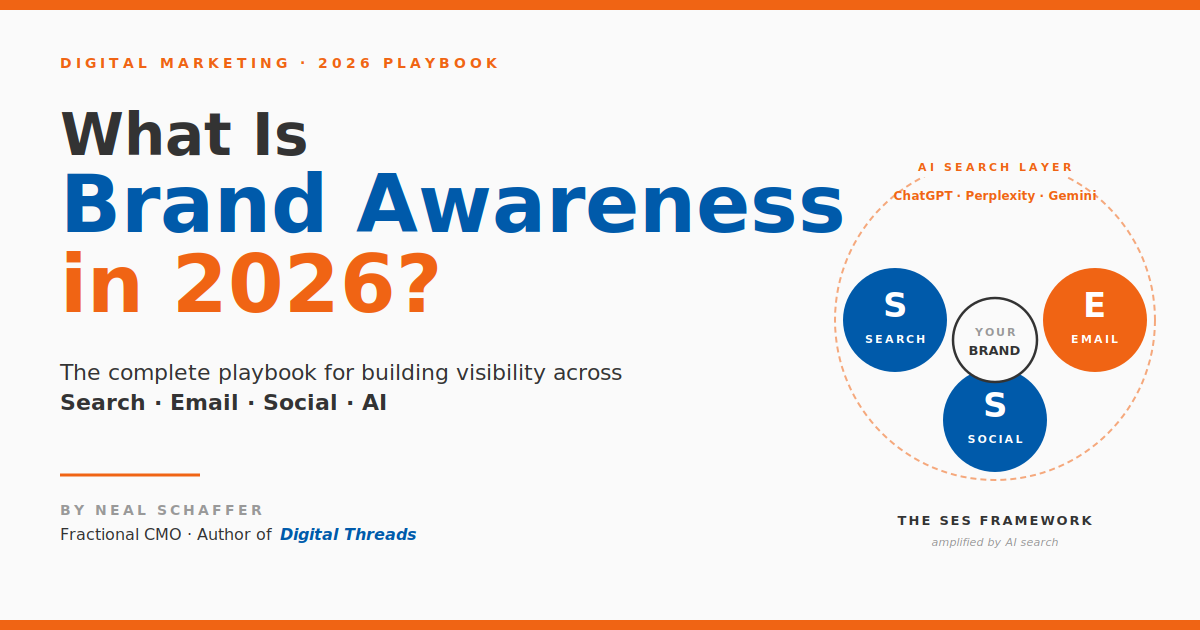
rewrite this title in spanish What Is Brand Awareness in 2026? A Digital Marketer’s Guide
rewrite A few times over the past year, prospective clients reached out about Fractional CMO work or personal branding consulting and told me upfront how they found me. Not Google. Not LinkedIn. Not a podcast recommendation. ChatGPT had named me when they asked for someone in my space. That caught my attention. I’ve spent two decades building visibility on traditional search engines and social media. But here was a new gatekeeper, one I hadn’t intentionally optimized for, deciding I belonged on a shortlist of people worth talking to. And the conversion quality was striking. Inquiries that came from AI recommendations tended to arrive already convinced. They’d done their research inside the chat, weighed the options, and picked up the phone. That opened my eyes to a new definition of what brand really means in the post-generative AI era. It’s no longer just what your customers remember about you. It’s what the machines summarizing the internet remember about you, and then pass along to your future customers without you ever knowing it happened. Brand awareness used to be a soft metric. The kind that lived on a slide in the awareness layer of the funnel, got measured in surveys once a year, and stayed out of the conversation when CFOs asked about ROI. That era is over. In 2026, brand awareness is the difference between being part of the conversation and being invisible in it, and the conversation is happening across Google, ChatGPT, Perplexity, Gemini, Claude, LinkedIn feeds, email inboxes, and Spotify playlists all at once. I’ve spent the last decade helping companies show up in those conversations, both as a Fractional CMO and as the author of Digital Threads, where I lay out the SES Framework (Search, Email, Social) that runs through this guide. This is the playbook I use with clients who need to be found, remembered, and recommended in a fragmented digital landscape, whether the recommender is a human, a search engine, or a large language model. Key Takeaways ✅ Brand awareness is the share of your target audience that recognizes and remembers your brand. It splits into brand recognition (cued recall, like spotting your logo) and brand recall (unaided recall, naming your brand when prompted by a category). ✅ Trust now sits alongside price and quality as a purchase driver. Edelman’s 2025 Trust Barometer Special Report on Brand Trust found that 80% of people now trust the brands they use, and trust has become a strategic battleground for competitive advantage. ✅ Build awareness across the SES Framework, not just one channel. Search makes you discoverable for years, email keeps you in the inbox of people who already know you, and social media spreads your voice through algorithms and advocates. ✅ AI search has rewritten the rules of brand visibility. AirOps research analyzing over 21,000 brand mentions found that 85% of brand mentions in AI responses come from third-party sources rather than the brand’s own website, which means earned media and review platforms now drive AI citations. ✅ B2B brand awareness has become the top business priority. LinkedIn’s 2025 B2B Marketing Benchmark with Ipsos found that 42% of senior B2B marketers rank increasing brand awareness and reputation among decision-makers as their single most important goal for the year. ✅ Measurement still matters, but the metrics have changed. Branded search, direct traffic, share of voice, AI citation rate, and third-party mentions tell you more than impressions or likes ever did. What Is Brand Awareness? Brand awareness is the extent to which your target audience can recognize and recall your brand when they encounter it or when they think about the category you serve. It has two distinct components, recognition (knowing your brand when shown) and recall (naming your brand when prompted by a need), both shaping whether a buyer ever considers you. Most people use “brand awareness” as a catch-all, but those two components behave very differently in practice. Recognition is what happens when a buyer sees your logo on a sponsored post and thinks, “oh, I’ve heard of them.” Recall is what happens when that same buyer needs a CRM and types “best CRM for small business” into ChatGPT without your name in mind, then either sees your brand named or doesn’t. The brands that win consistently are the ones that build recall, not just recognition. Recall is harder, slower, and worth far more. Why Has Brand Awareness Become More Critical in 2026? Brand awareness has become more critical in 2026 because the discovery layer has fragmented. Buyers now research across Google, ChatGPT, Perplexity, Gemini, LinkedIn, YouTube, and TikTok, and AI systems summarize options before the buyer ever clicks a link. If your brand isn’t named in those summaries, you’re not on the shortlist. Gartner forecasted in early 2024 that traditional search engine volume would drop 25% by 2026, with search marketing losing share to AI chatbots and virtual agents. Whether that exact number has already landed is up for debate, but the directional shift is undeniable. Branded queries are increasingly happening inside ChatGPT and Perplexity, and the brands that show up in those answers are pulling ahead of the ones that don’t. This shift is showing up in budget priorities. The LinkedIn study cited in Key Takeaways found that 94% of B2B marketers now agree trust is the most important factor in B2B success, and a plurality of senior marketers are putting brand reputation ahead of demand generation as their primary objective. That’s a meaningful inversion of the last decade’s “always be converting” mindset. It’s also showing up in how content marketing performs. According to the Content Marketing Institute’s 15th annual B2B benchmarks, 87% of B2B marketers report that content marketing helped them create brand awareness in the past 12 months, making it the single most-cited outcome of their content investment, ahead of demand generation, lead nurturing, and sales. And then there’s the AI piece, which I’ll come back to in its own section. Short version: the brands that show up inside AI answers tend to share three traits. They have strong third-party citation footprints, they publish original data, and they reinforce a consistent entity across the web. What’s the Difference Between Brand Awareness, Brand Recognition, and Brand Recall? Brand awareness is the umbrella term that covers both recognition and recall. Recognition is aided awareness, where a buyer identifies your brand when shown a logo, ad, or name in a list. Recall is unaided awareness, where a buyer names your brand from memory when prompted by a category or need. Recall is harder and more commercially valuable. Is Your LinkedIn Not Delivering Results? Just released: my new book to help professionals, entrepreneurs, and business owners maximize LinkedIn for real growth.With years of LinkedIn expertise, Maximizing LinkedIn for Business Growth offers actionable steps to build your brand, expand your network, and drive results. Start leveraging LinkedIn like never before—grab your copy now! Click the cover or button below to buy on Amazon. Here’s a side-by-side breakdown so the terminology lines up: TermWhat It MeansHow It’s MeasuredWhy It MattersBrand AwarenessTotal share of your audience that knows your brand existsAided + unaided recall surveys, share of voice, branded search volumeThe umbrella metric for top-of-funnel visibilityBrand RecognitionBuyers identify your brand when shown a cue (logo, ad, name)Aided recall surveys, ad recall studiesIndicates visual identity strength and ad effectivenessBrand RecallBuyers name your brand from memory when given a category promptUnaided recall surveys, top-of-mind awareness scoresPredicts inclusion in the consideration set during buying decisionsShare of VoiceYour brand’s portion of total conversation in your categoryMention volume, search share, social listeningTracks competitive visibility against direct rivalsBrand SalienceHow easily and how often your brand comes to mind in buying situationsCategory-cued recall, mental availability researchLinks awareness directly to purchase behavior Recognition is what happens when a buyer sees your logo and thinks “I’ve heard of them.” Recall is what happens when a buyer needs a CRM and asks ChatGPT without your name in mind. Both are brand awareness. Only one predicts purchase. If you want to go deeper on the share-of-voice piece, I’ve broken down how it compares to share of market in a separate explainer on share of voice versus share of market, because the two get confused constantly in client conversations. How Does Brand Awareness Fit Into the Marketing Funnel? Brand awareness sits at the top of the marketing funnel, where buyers move from “don’t know you exist” to “have heard of you.” It’s the prerequisite for every later stage. A buyer can’t consider you, prefer you, or purchase from you if they’ve never encountered your name. Awareness is the door, not the room. That’s the textbook version. The reality in 2026 is messier. Buyer journeys loop and circle back. A widely-cited 2020 FocusVision study reported by MarTech found the average B2B buyer consumes 13 pieces of content before making a vendor decision, split roughly eight vendor-created and five third-party. That number is from before the AI search era and is almost certainly higher today across more fragmented channels. People discover you on TikTok, forget you for three months, see your name in a Perplexity answer, then sign up for your newsletter from a podcast mention. Awareness happens in fragments, across channels, over time. The textbook funnel still gets drawn on slides, but the 2026 reality is a buyer who finds you on TikTok, forgets for three months, then bumps into your name in a Perplexity answer before signing up for your newsletter. Awareness happens in fragments. What hasn’t changed is the principle. If the goal is purchase, you need awareness first. If the goal is loyalty, you need awareness sustained. If the goal is advocacy, you need awareness that’s emotionally resonant enough for people to want to talk about it. The SES Framework from Digital Threads breaks brand awareness into three channels. Search makes you discoverable for years. Email keeps you in inboxes that already know you. Social spreads your voice through algorithms and advocates. How Do You Build Brand Awareness Through Search? Building brand awareness through search means publishing discoverable, evergreen content that answers the questions your target audience is already typing into Google, YouTube, Amazon, and increasingly into ChatGPT and Perplexity. Search is the first “S” in my SES Framework because content indexed in a search engine works for years, while a social post fades in hours. The most reliable awareness compound I’ve seen with clients is a blog backed by a clear keyword strategy. Not random thought leadership. Not “what’s on my mind today” posts. Content built around questions that have real search demand and that match the buyer’s stage. That requires real keyword research, the kind I describe in my SEO strategy resource, and patience to wait six to twelve months for the compounding effect to kick in as you build the library of content I describe in detail in Digital Threads. Three search tactics consistently move the awareness needle: Long-form evergreen content answering specific buyer questions, supported by topical clusters that build authority around a theme. Authority signals through earned backlinks and citations. The mechanics of why backlinks matter for SEO is its own rabbit hole worth understanding. YouTube and podcast presence because both platforms function as search engines with multi-year content shelf life, and Google now surfaces video and audio prominently in mixed-media results. Search rewards maintenance more than volume, which is why the content still bringing me clients today is the content I went back and refreshed periodically. How Do You Build Brand Awareness Through Email? Building brand awareness through email means showing up in inboxes consistently enough that your name becomes familiar, not just transactionally useful. Email is the “E” in SES because once a subscriber opts in, you have permission to keep reinforcing your brand with every send, even when most of those sends go unopened. The subject line alone is a brand impression. I’ve worked with clients who treated email as a conversion channel only, sending exclusively when they had something to sell. The result was unsubscribes, predictably. The clients who treated email as a relationship channel, sending a weekly or biweekly newsletter with genuine value, saw their open rates climb and their direct-traffic-from-email numbers compound over a year or two. A few things that matter for awareness specifically, separate from conversion: A recognizable sender name and subject line voice so subscribers know it’s you before they open. Having a defined brand voice pays off across every send. Consistency over frequency. A predictable weekly newsletter outperforms sporadic blasts every time. Subscribers learn to expect you. Forwardable, citable content. When a subscriber forwards your email to a colleague, that’s earned awareness with zero acquisition cost. Write at least one section per send with that in mind. Building brand awareness through social media means creating content that the platform’s algorithm wants to show to people who don’t follow you yet, while keeping the people who already follow you engaged. Social is the second “S” in SES, and it’s the channel where awareness can compound fastest, but also where it disappears fastest if you stop showing up. The 2025 Sprout Social Index reported that social media has become the number one source consumers use to keep up with trends and culture, ranking ahead of TV, family and friends, and every other digital channel. That’s a meaningful shift. It means social isn’t just a marketing channel, it’s a discovery layer that competes with traditional media for attention. As Scott Morris, Chief Marketing Officer at Sprout Social, put it when announcing the findings: “Consumer demands grow increasingly sophisticated with each year, and this year is no different. The 2025 Index report illustrates how consumers expect meaningful engagement and cultural relevance on social media that goes beyond trend-chasing.” That’s the bar in 2026. Posting consistently isn’t enough. Posting with cultural fluency and authenticity is what builds brand recall. A few principles that hold across platforms: Pick two or three platforms where your audience actually spends time, and go deep. Spreading thin across six channels is a recipe for inconsistent presence and inconsistent awareness. I’ve watched too many clients try to be everywhere and end up nowhere. Build a consistent visual and verbal identity. Adobe Express is the design tool I personally use for this, because the template system and brand kit feature make it realistic to keep visual identity consistent across hundreds of posts a year (full disclosure, I’m an Adobe Express Brand Ambassador, so I’m biased, but I’ve been recommending it for the same reasons since before that relationship existed). Bring in other voices. Influencer partnerships, especially with micro-influencers who have tight community trust, extend your awareness into audiences your own accounts can’t reach organically. Treat customer care on social as awareness work. Public replies are seen by future customers, not just the person you’re replying to. Every well-handled support exchange is a brand impression for an audience. If you’re trying to think holistically about how these pieces fit together, I’ve written more on building a coordinated social media strategy that aligns the awareness, engagement, and conversion layers. How Do You Build Brand Awareness Inside AI Search and ChatGPT? Building brand awareness inside AI search means earning citations and mentions from the third-party sources that AI models trust most, because AI systems synthesize answers by retrieving from external sources rather than generating from scratch. The discipline is called Generative Engine Optimization (GEO) or Answer Engine Optimization (AEO), and it’s reshaping what brand awareness even means. The AirOps research mentioned in Key Takeaways is the clearest signal I’ve seen. When an AI tool names your brand in a top-of-funnel commercial query, that mention is six and a half times more likely to come from a third-party source than from your own website. Which means the old SEO playbook of “rank our pages first” only partially translates. You also need to be cited on the sites the AI is reading. AI search has rewired brand awareness. Your own website does roughly 15% of the work. The other 85% lives on review platforms like G2 and Clutch, Wikipedia entries, Reddit threads, podcast transcripts, and news coverage you don’t control. Earned media is the new SEO. Here’s the practical implication for a brand awareness strategy: Get into review sites and aggregators. G2, Capterra, Trustpilot, and category-specific roundups disproportionately shape what AI models say about your category. Pursue earned media coverage. A placement on a publication the AI considers authoritative is worth more in 2026 than ten guest posts on low-authority blogs. Publish original research and statistics. Content with cited statistics earns more AI mentions than opinion pieces. This is one reason I keep my annual social media marketing statistics roundup up to date on my own site. Reinforce entity consistency. Use the same name, the same role descriptions, and the same key facts about your brand across every site that mentions you. AI models penalize ambiguity. There’s also a measurement layer to this. HubSpot’s AEO product, launched in early 2026, tracks brand visibility scores and share of voice across ChatGPT, Gemini, and Perplexity, and HubSpot reported on their own results that AEO became one of their fastest-growing lead sources with leads converting at three times the rate of traditional search. The tooling is maturing fast, and the brands that start measuring AI visibility now will have a year-plus head start on those who wait. How Do You Measure Brand Awareness? Measuring brand awareness in 2026 requires a mix of legacy metrics (branded search, direct traffic, social mentions) and emerging ones (AI citation rate, share of voice across LLMs, third-party mention quality). No single number tells the full story, which is why most marketers track a portfolio of signals and look for direction over time rather than precision in any given month. Here’s the measurement portfolio I recommend to clients, organized by what each metric actually tells you: Brand awareness measurement has evolved in three layers. The foundations (branded search, direct traffic) still matter. The competitive layer (share of voice, brand recall) tells you where you stand against rivals. The emerging layer (AI citation rate, third-party mention volume) is what 2026 added to the stack, and it’s where the next year of category leadership will be decided. MetricWhat It TracksWhere to Find ItBranded search volumeHow often people type your brand name into GoogleGoogle Search Console, Google TrendsDirect trafficVisitors typing your URL directly or using a bookmarkGoogle Analytics 4Share of voiceYour portion of category conversation across earned mediaSocial listening tools, Mention, Brand24Aided and unaided brand recallSurvey-based memory of your brand in your categoryQuarterly brand tracker surveysSocial mentions volume and sentimentHow often and how favorably people talk about youNative platform analytics, Sprout Social, BrandwatchAI citation rateHow often your brand appears in AI-generated responsesProfound, Otterly.AI, Semrush AI ToolkitThird-party mention volumeCoverage on review sites, news sites, podcastsManual tracking + tools like Ahrefs Brand RadarReferral traffic from earned mediaVisitors arriving from publications, podcasts, and partnersGoogle Analytics 4 The mistake I see most often is over-weighting impressions and likes, which feel measurable but barely correlate with anything that matters. A million Instagram impressions on a video nobody remembers is a worse business outcome than 50,000 impressions on a post that drives 500 newsletter signups and a podcast download spike. What Most Brand Awareness Guides Get Wrong Most brand awareness guides treat it as a top-of-funnel activity disconnected from revenue, which leads to vanity-metric thinking and budget cuts the moment a CFO asks ROI questions. The reframe I work from: awareness is a leading indicator of every conversion metric you care about, but only when it’s measured against the segment of the audience you can actually sell to. A few specific things guides routinely miss: Confusing reach with awareness. Reach is exposure. Awareness is memory. They’re not the same, and the difference is the gap between “they saw it” and “they remember it.” Memory takes repetition. Treating awareness as a one-time campaign. Awareness decays. Without sustained reinforcement, the brands you built recognition for last year fade out of consideration sets this year. Plan for ongoing investment, not a launch sprint. Skipping the entity layer. Especially with AI search now in the picture, brands that show up consistently across the web (with the same name, same description, same fact pattern) get cited far more than brands that drift in their positioning. Picking the wrong tactics for the funnel stage. Influencer awareness campaigns make sense at the top of the funnel. Retargeting ads for “brand awareness” mostly waste money because the audience already knows you exist. The other miss I see constantly, even from experienced marketers, is treating brand awareness as separate from content strategy. They’re the same thing. Every blog post, video, newsletter, and social asset is a brand awareness vehicle if it’s published consistently in your voice. For more on that integration, my post on what content marketing actually is lays out how content ties to brand building. And the financial case has gotten harder to ignore. Kantar BrandZ has tracked the world’s biggest brands for two decades, and the companies sitting at the top of its value rankings have historically delivered higher shareholder returns than the broad market, even across rough years. Brand investment isn’t a cost. It’s a balance sheet asset that compounds. Brand Awareness FAQ What’s a realistic timeline for seeing brand awareness improve? Realistic timelines depend on your starting point and channel mix, but in my consulting work I tell clients to expect three to six months of consistent effort before they see meaningful lift in branded search and direct traffic, and twelve to eighteen months before they see compound effects across multiple channels. Awareness doesn’t lift overnight. It accrues. How much should I budget for brand awareness versus performance marketing? There’s no universal split, but Les Binet and Peter Field’s “The Long and the Short of It” research for the IPA, based on nearly 1,000 effectiveness case studies, found that a roughly 60/40 brand-to-activation allocation produces the strongest long-term growth in most consumer categories, with the brand portion higher for newer or less-known companies. The mistake is going 100% performance and wondering why CAC keeps climbing. You can’t convert someone who’s never heard of you. Is brand awareness measurable, or is it inherently fuzzy? It’s measurable, but not with a single number. You measure it through a portfolio of signals (branded search, direct traffic, share of voice, AI citation rate, survey-based recall) and you watch the trendline. Anyone selling you a “brand awareness score” as a single metric is oversimplifying, but the inputs that feed that score are absolutely trackable. Does brand awareness still matter if I’m primarily selling through paid ads? Yes, and probably more than you think. Branded queries convert at significantly higher rates than unbranded queries, and ad creative tested with audiences who already recognize the brand consistently outperforms creative shown to cold audiences. Paid ads work better when the brand is already known. That’s why category leaders can afford lower CACs than their challengers. How is brand awareness different from brand identity? Brand identity is the set of visual, verbal, and emotional cues you control (your logo, voice, story, design system, values). Brand awareness is the share of your audience that recognizes those cues. Identity is what you create. Awareness is what gets retained. The two work together, but they’re distinct, and conflating them is one reason a lot of brand strategy work goes sideways. I’ve written more on the brand storytelling side of identity if you want to go deeper there. Start Building Brand Awareness That Compounds Brand awareness in 2026 is not a quarterly campaign. It’s an ongoing system across search, email, social, and AI answer engines, all reinforcing the same entity for the same audience. The brands that win show up consistently, publish content worth citing, and measure progress against signals that predict revenue rather than vanity metrics. If you’re trying to ground your brand awareness strategy in current data, the latest content marketing statistics are a useful place to start, because content marketing is doing more of the awareness-building work in 2026 than any other tactic. And if you’d like hands-on help building a coordinated awareness strategy across your full digital footprint, download a free preview of Digital Threads for the full SES Framework, or get in touch about Fractional CMO services if you want me involved directly. The discovery layer keeps changing. The discipline of showing up where your buyers are doesn’t. Actionable advice for your digital / content / influencer / social media marketing. Join 13,000+ smart professionals who subscribe to my regular updates. in spanish


rewrite this title in spanish Marketers Share What Makes Traackr the Top Influencer Marketing Platform I Traackr
rewrite this content in spanish If you’re an influencer marketer, then you know that a lot of your time can get sucked into dull or unnecessarily complicated tasks. Using an influencer marketing platform can make your job significantly easier!However, bringing on an influencer marketing platform is no small task. They aren’t cheap, and there are a lot to choose from. Of course, if you asked us we’d (very biasedly) say that Traackr is the best influencer marketing platform out there. We have the largest global influencer data set, the most thorough influencer discovery and vetting feature, one-of-a-kind market benchmarking… all things you can learn by scrolling on our website. So what kind of value does Traackr actually bring to marketers that use it?Below read real reviews from real marketers who use and love Traackr’s influencer marketing platform. And, if this article ends up convincing you, contact us. 😉 “What I like best about Traackr is that the platform offers full functionality. You can search for content creators, but also run a full campaign from the tool – you can track potential reach, impressions, engagements, conversions, ROI data, and more. Traackr has helped us elevate how we set up and run our campaigns. It has also helped us be more informed so that we can make better decisions on future campaigns.” — Meredith W, G2 Crowd Review of TraackrMarketers Share What Makes Traackr the Top Influencer Marketing PlatformTraackr Makes Influencer Discovery and Vetting More Efficient“Traackr helps me to save time while I research and select influencers for various international campaigns. I love how I can easily see all the stats from the influencers and that can help with making quicker decisions.” — G2 Crowd Review of TraackrSome influencer marketing platforms have a restrictive influencer database where you can only discover influencers on a certain platform or country. With Traackr’s influencer marketing platform you can search for influencers in 71 countries, 26 languages and 13 platforms, drilling down with:Extensive influencer data. Search by influencer socio-demographic criteria such as job title, gender, location, language, platform, follower count, and engagement rate.Key audience demographics. Find influencers with audiences that align with your target by honing in on age, gender, language, ethnicity, location, interests, and brand affinityIn-depth content search tools. Quickly and easily sift through potential partner’s past content with Traackr’s keyword search, or look by interests, hashtags, or brand mentions. KPI benchmarks based on historical data. Gain insights into how your brand and competitors’ influencer content is performing.Get proactive recommendations. Traackr offers automated recommendations of new influencers talking about your brand, competitors, and key topics of interest. It also allows you to discover influencers with similar audience demographics or similar content, as well as people who follow these influencers and have a large audience.“I really like the metrics Traackr shows to compare different influencer profiles, so you can quickly check if the profile matches your interests or not. I also like that you can search using keywords they used in their content, so you can find new profiles easily.” — Carla M, G2 Crowd Review of TraackrTraackr’s Influencer Marketing Platform Helps Keep Teams Aligned and Organized “By getting everyone on the same page, using the same technology, with transparent access to data, we all gained better visibility into what works most efficiently so we can confidently invest more.” — Barbara Mugica, Associate Director for Personal Care Digital Marketing at Colgate-Palmolive EuropeFor teams of all sizes it’s important to have all influencer details and data in one place. For many marketers, Traackr serves as a kind of relationship management technology for their influencer partnerships. This helps them streamline activations, collaborate efficiently and keep information organized and transparent.So what kinds of data and actions do marketers store in Traackr’s influencer marketing platform? Here’s a short list:Relationship management. Marketers like that Traackr allows them to segment influencers by custom groups, so they can quickly find the right folks for specific campaigns (they can group by topics, tiers, archetypes, etc). Traackr also allows brands to assign relationship ownership to individual team members and track relationship stages — this is critical, as much of influencer marketing is based on strong relationship building! Project management. Sometimes influencer marketing campaigns can get messy, especially when you’re working on a tight deadline (which is almost always the case). Traackr gives teams the option to define workflows so every teammate knows what to do, and who to get reviews/approvals from. Marketers can also add notes to influencer profiles to track activities and share valuable information with fellow teammates. Performance metrics and spend efficiency. All teammates have access to the same performance data for each influencer and campaign. They can also track how much the team spent and report back on impact for each influencer — no better way to get smarter with your spending!“The best part of Traackr has to be the ability to jump into each separate campaign and see the exact progress of the campaign and the results at any given moment. Working for an agency is a crucial benefit when working across multiple brands and campaigns at any given time.” — Nick G, G2 Crowd Review of TraackrTraackr isn’t just an influencer platform that optimizes collaboration across teams, it also streamlines influencer communication, making onboarding and managing influencers fast and efficient. What does that really mean? No more DMing influencers on a billion different platforms. Marketers can send personalized emails to their influencers individual and en masse, through Traackr. They can also send notifications to influencers for new campaigns and content change requests/approvals, and even invite them onboard to new product seeding campaigns. Tip: Traackr Studios streamlines product seeding with a landing page outlining details of the gifting campaign – influencers can even make product selections!Traackr Helps Marketers Understand Influencer Marketing ROI“The most helpful thing about the Traackr platform is that it helps marketers invest in the right campaigns and programs that scale globally.” — Steven P, G2 Crowd Review of TraackrAn efficient influencer marketing platform provides you with the data you need to make your influencer marketing spending more efficient, maximize your ROI, and understand how you’re stacking up against your competition.“Having worked in social media for many years, and having tried many platforms – Traackr definitely offers the most in-depth analytics and reporting that I’ve ever used. They work across all platforms, offer compelling competitive data, and have excellent customer service. Their international capabilities are also fantastic, which are crucial when working for a global company.” — G2 Crowd Review of TraackrTraackr makes it easier for brands to keep influencer campaigns aligned with a company’s strategies and goals by providing up-to-date data on:Cost efficiency. Traackr gives marketers easy access to cost efficiency metrics (e.g. cost per view, cost per post, etc.) so they know exactly who packs a bigger punch when it comes to ROI.Campaign effectiveness. Marketers like that Traackr makes it easy to measure campaigns across all major social platforms. They can track desired outcomes like awareness, engagements, or conversions and drill into the content and creators behind them.Program performance. For marketers at larger brands, they love that Traackr allows them to track all KPIs and spend over time and across markets, brands, categories, campaigns, campaign types, influencers, platforms, and tiers. This allows them to monitor the health of their program and identify opportunities to optimize!Last but not least, not many influencer marketing platforms can say that they’ve created a metric specifically for influencer marketing, but Traackr did just that! In 2019, Traackr introduced the Brand Vitality Score (VIT) to help marketers better understand the performance of their influencer marketing campaigns and how to optimize. VIT provides all the complexity in influencer marketing in a single metric. VIT can be used to determine the success of your ROI and spend, the performance of a post or campaign, and where your brand ranks among competitors. You can learn more about VIT here, or see which beauty and fashion brands are winning in influencer marketing performance (by VIT) here. Still wanting to know more? Check out how these brands use Traackr’s influencer marketing platform:

37 Estadísticas Importantes de TikTok que los Marketers Necesitan Conocer [2024]
Si eres un especialista en marketing que busca impactar en TikTok, entonces necesitas conocer las últimas estadísticas y tendencias de TikTok. Aunque la plataforma se hizo famosa como un espacio para desafíos de baile de la Generación Z, TikTok ha crecido para abarcar todo tipo de contenido y comunidad. De hecho, con funciones como compras en la aplicación, transmisiones en vivo y desafíos de hashtag de marca, ahora es una herramienta esencial para las marcas que buscan conectarse directamente con los clientes. (Qué bueno que finalmente es posible programar publicaciones de TikTok). Mientras desarrollas tu estrategia de marketing en TikTok, aquí están las estadísticas clave de TikTok a tener en cuenta. #1 Herramienta de redes sociales Crea. Programa. Publica. Participa. Mide. Gana. Prueba gratuita de 30 días Estadísticas generales de TikTok
Desde su lanzamiento en 2016, TikTok ha aumentado vertiginosamente a través de la esfera de aplicaciones para capturar los corazones y la atención de los usuarios de redes sociales, con algunos números realmente impresionantes. Aquí están las estadísticas generales de TikTok que necesitas saber. TikTok alcanzó 1.92 mil millones de usuarios en 2023
Más de mil millones de personas ahora cantan, bailan, actúan y compran en TikTok. La aplicación alcanzó asombrosamente 1.92 mil millones de usuarios en 2023, un aumento del 16% respecto al año anterior. Se espera que la aplicación alcance los 2 mil millones para finales de 2024.
Douyin, la versión china de TikTok, tiene 750 millones de usuarios activos diarios
Aunque TikTok domina en muchos países, la versión china de la aplicación, Douyin, tiene 750 millones de usuarios activos diarios a partir de 2023.
TikTok es la aplicación más descargada en más de 40 países
El ascenso en popularidad de TikTok ha sido rápido y global. La aplicación es la más descargada en más de 40 países y actualmente está disponible en más de 150 mercados y 35 idiomas.
TikTok ocupa el quinto lugar en la App Store de Apple
En 2023, TikTok se convirtió en la quinta aplicación más descargada en la App Store de Apple, superando a otras aplicaciones populares como Facebook, Instagram y Snapchat, pero quedando por detrás de recién llegadas como Temu y CapCut (aunque estas aplicaciones están, a todas luces, relacionadas estrechamente con el ascenso de TikTok).
TikTok vale $50 mil millones en el NASDAQ
TikTok vale una asombrosa cantidad de $50 mil millones a partir de 2024. Se estima que su empresa matriz, ByteDance, también vale $275 mil millones.
TikTok está limitando el tiempo que los adolescentes pueden pasar en la aplicación
En 2023, TikTok anunció que limitaría a los menores a una hora al día en la aplicación en un esfuerzo por promover hábitos más saludables de uso de la pantalla. Los usuarios de 13 a 17 años recibirán una alerta después de una hora de uso y tendrán la opción de ingresar un código para una hora adicional. Los niños menores de 13 años requerirán permiso de los padres y un código para hasta 30 minutos de uso adicional.
El 90% de los usuarios de TikTok reportan que la plataforma los hace felices
Según TikTok, el 90% de los usuarios dicen que la aplicación los hace felices. También informan que nunca se aburren.
TikTok ocupa el séptimo lugar en las aplicaciones más confiables para las marcas
Aunque TikTok puede ser popular entre los adolescentes, las marcas establecidas tienen menos confianza en la plataforma de redes sociales que competidores como LinkedIn, Instagram y WhatsApp. Pero, oye, sigue superando a X (anteriormente conocido como Twitter) y Threads, ocupando los puestos 9 y 10, respectivamente. Estadísticas de usuarios de TikTok
Probablemente tengas una imagen amplia en tu cabeza de quién es el usuario promedio de TikTok, pero la verdad es que no todos en la plataforma son imitadores de Billie Eilish. Aquí hay algunas estadísticas de usuarios de TikTok a tener en cuenta. El 18.2% de la audiencia global de TikTok eran mujeres de 18 a 24 años
A pesar de la reputación de adolescente de TikTok, el 18.2% de su audiencia global está formada por mujeres de 18 a 24 años. Las usuarias femeninas de 25 a 34 años representan el 16.3% de los usuarios de la plataforma.
Los jóvenes usuarios masculinos representan el 18% de la audiencia de TikTok
Por otro lado, aproximadamente el 18% de los usuarios de TikTok son hombres de entre 18 y 24 años.
El 29% de los usuarios de TikTok abren la aplicación todos los días
TikTok es la segunda aplicación más atractiva después de Instagram, con el 29% de sus instalaciones activas abriendo la aplicación diariamente.
Los adultos de Estados Unidos pasan 4.43 mil millones de minutos al año en TikTok
A partir de 2023, los adultos estadounidenses pasan un total de 4.43 mil millones de minutos al día en TikTok. Esto es más de cinco veces la cantidad de tiempo que pasaron en 2019. Insider Intelligence predice que para 2025, TikTok superará a todas las demás aplicaciones de redes sociales en minutos diarios gastados. …