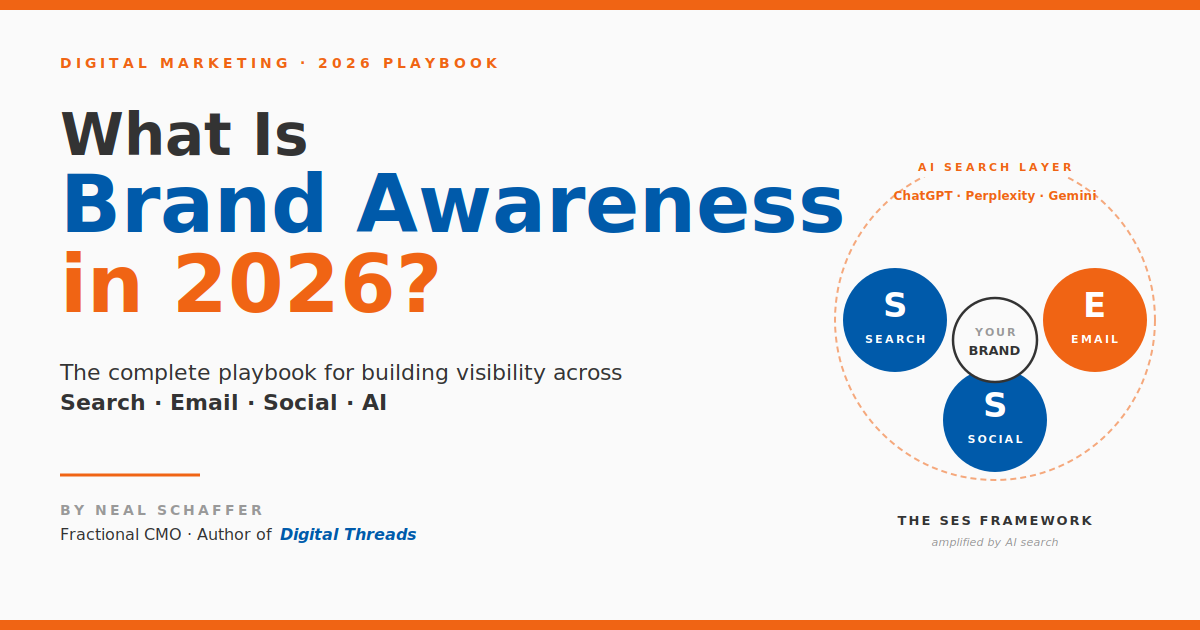
rewrite this title in spanish What Is Brand Awareness in 2026? A Digital Marketer’s Guide
rewrite A few times over the past year, prospective clients reached out about Fractional CMO work or personal branding consulting and told me upfront how they found me. Not Google. Not LinkedIn. Not a podcast recommendation. ChatGPT had named me when they asked for someone in my space. That caught my attention. I’ve spent two decades building visibility on traditional search engines and social media. But here was a new gatekeeper, one I hadn’t intentionally optimized for, deciding I belonged on a shortlist of people worth talking to. And the conversion quality was striking. Inquiries that came from AI recommendations tended to arrive already convinced. They’d done their research inside the chat, weighed the options, and picked up the phone. That opened my eyes to a new definition of what brand really means in the post-generative AI era. It’s no longer just what your customers remember about you. It’s what the machines summarizing the internet remember about you, and then pass along to your future customers without you ever knowing it happened. Brand awareness used to be a soft metric. The kind that lived on a slide in the awareness layer of the funnel, got measured in surveys once a year, and stayed out of the conversation when CFOs asked about ROI. That era is over. In 2026, brand awareness is the difference between being part of the conversation and being invisible in it, and the conversation is happening across Google, ChatGPT, Perplexity, Gemini, Claude, LinkedIn feeds, email inboxes, and Spotify playlists all at once. I’ve spent the last decade helping companies show up in those conversations, both as a Fractional CMO and as the author of Digital Threads, where I lay out the SES Framework (Search, Email, Social) that runs through this guide. This is the playbook I use with clients who need to be found, remembered, and recommended in a fragmented digital landscape, whether the recommender is a human, a search engine, or a large language model. Key Takeaways ✅ Brand awareness is the share of your target audience that recognizes and remembers your brand. It splits into brand recognition (cued recall, like spotting your logo) and brand recall (unaided recall, naming your brand when prompted by a category). ✅ Trust now sits alongside price and quality as a purchase driver. Edelman’s 2025 Trust Barometer Special Report on Brand Trust found that 80% of people now trust the brands they use, and trust has become a strategic battleground for competitive advantage. ✅ Build awareness across the SES Framework, not just one channel. Search makes you discoverable for years, email keeps you in the inbox of people who already know you, and social media spreads your voice through algorithms and advocates. ✅ AI search has rewritten the rules of brand visibility. AirOps research analyzing over 21,000 brand mentions found that 85% of brand mentions in AI responses come from third-party sources rather than the brand’s own website, which means earned media and review platforms now drive AI citations. ✅ B2B brand awareness has become the top business priority. LinkedIn’s 2025 B2B Marketing Benchmark with Ipsos found that 42% of senior B2B marketers rank increasing brand awareness and reputation among decision-makers as their single most important goal for the year. ✅ Measurement still matters, but the metrics have changed. Branded search, direct traffic, share of voice, AI citation rate, and third-party mentions tell you more than impressions or likes ever did. What Is Brand Awareness? Brand awareness is the extent to which your target audience can recognize and recall your brand when they encounter it or when they think about the category you serve. It has two distinct components, recognition (knowing your brand when shown) and recall (naming your brand when prompted by a need), both shaping whether a buyer ever considers you. Most people use “brand awareness” as a catch-all, but those two components behave very differently in practice. Recognition is what happens when a buyer sees your logo on a sponsored post and thinks, “oh, I’ve heard of them.” Recall is what happens when that same buyer needs a CRM and types “best CRM for small business” into ChatGPT without your name in mind, then either sees your brand named or doesn’t. The brands that win consistently are the ones that build recall, not just recognition. Recall is harder, slower, and worth far more. Why Has Brand Awareness Become More Critical in 2026? Brand awareness has become more critical in 2026 because the discovery layer has fragmented. Buyers now research across Google, ChatGPT, Perplexity, Gemini, LinkedIn, YouTube, and TikTok, and AI systems summarize options before the buyer ever clicks a link. If your brand isn’t named in those summaries, you’re not on the shortlist. Gartner forecasted in early 2024 that traditional search engine volume would drop 25% by 2026, with search marketing losing share to AI chatbots and virtual agents. Whether that exact number has already landed is up for debate, but the directional shift is undeniable. Branded queries are increasingly happening inside ChatGPT and Perplexity, and the brands that show up in those answers are pulling ahead of the ones that don’t. This shift is showing up in budget priorities. The LinkedIn study cited in Key Takeaways found that 94% of B2B marketers now agree trust is the most important factor in B2B success, and a plurality of senior marketers are putting brand reputation ahead of demand generation as their primary objective. That’s a meaningful inversion of the last decade’s “always be converting” mindset. It’s also showing up in how content marketing performs. According to the Content Marketing Institute’s 15th annual B2B benchmarks, 87% of B2B marketers report that content marketing helped them create brand awareness in the past 12 months, making it the single most-cited outcome of their content investment, ahead of demand generation, lead nurturing, and sales. And then there’s the AI piece, which I’ll come back to in its own section. Short version: the brands that show up inside AI answers tend to share three traits. They have strong third-party citation footprints, they publish original data, and they reinforce a consistent entity across the web. What’s the Difference Between Brand Awareness, Brand Recognition, and Brand Recall? Brand awareness is the umbrella term that covers both recognition and recall. Recognition is aided awareness, where a buyer identifies your brand when shown a logo, ad, or name in a list. Recall is unaided awareness, where a buyer names your brand from memory when prompted by a category or need. Recall is harder and more commercially valuable. Is Your LinkedIn Not Delivering Results? Just released: my new book to help professionals, entrepreneurs, and business owners maximize LinkedIn for real growth.With years of LinkedIn expertise, Maximizing LinkedIn for Business Growth offers actionable steps to build your brand, expand your network, and drive results. Start leveraging LinkedIn like never before—grab your copy now! Click the cover or button below to buy on Amazon. Here’s a side-by-side breakdown so the terminology lines up: TermWhat It MeansHow It’s MeasuredWhy It MattersBrand AwarenessTotal share of your audience that knows your brand existsAided + unaided recall surveys, share of voice, branded search volumeThe umbrella metric for top-of-funnel visibilityBrand RecognitionBuyers identify your brand when shown a cue (logo, ad, name)Aided recall surveys, ad recall studiesIndicates visual identity strength and ad effectivenessBrand RecallBuyers name your brand from memory when given a category promptUnaided recall surveys, top-of-mind awareness scoresPredicts inclusion in the consideration set during buying decisionsShare of VoiceYour brand’s portion of total conversation in your categoryMention volume, search share, social listeningTracks competitive visibility against direct rivalsBrand SalienceHow easily and how often your brand comes to mind in buying situationsCategory-cued recall, mental availability researchLinks awareness directly to purchase behavior Recognition is what happens when a buyer sees your logo and thinks “I’ve heard of them.” Recall is what happens when a buyer needs a CRM and asks ChatGPT without your name in mind. Both are brand awareness. Only one predicts purchase. If you want to go deeper on the share-of-voice piece, I’ve broken down how it compares to share of market in a separate explainer on share of voice versus share of market, because the two get confused constantly in client conversations. How Does Brand Awareness Fit Into the Marketing Funnel? Brand awareness sits at the top of the marketing funnel, where buyers move from “don’t know you exist” to “have heard of you.” It’s the prerequisite for every later stage. A buyer can’t consider you, prefer you, or purchase from you if they’ve never encountered your name. Awareness is the door, not the room. That’s the textbook version. The reality in 2026 is messier. Buyer journeys loop and circle back. A widely-cited 2020 FocusVision study reported by MarTech found the average B2B buyer consumes 13 pieces of content before making a vendor decision, split roughly eight vendor-created and five third-party. That number is from before the AI search era and is almost certainly higher today across more fragmented channels. People discover you on TikTok, forget you for three months, see your name in a Perplexity answer, then sign up for your newsletter from a podcast mention. Awareness happens in fragments, across channels, over time. The textbook funnel still gets drawn on slides, but the 2026 reality is a buyer who finds you on TikTok, forgets for three months, then bumps into your name in a Perplexity answer before signing up for your newsletter. Awareness happens in fragments. What hasn’t changed is the principle. If the goal is purchase, you need awareness first. If the goal is loyalty, you need awareness sustained. If the goal is advocacy, you need awareness that’s emotionally resonant enough for people to want to talk about it. The SES Framework from Digital Threads breaks brand awareness into three channels. Search makes you discoverable for years. Email keeps you in inboxes that already know you. Social spreads your voice through algorithms and advocates. How Do You Build Brand Awareness Through Search? Building brand awareness through search means publishing discoverable, evergreen content that answers the questions your target audience is already typing into Google, YouTube, Amazon, and increasingly into ChatGPT and Perplexity. Search is the first “S” in my SES Framework because content indexed in a search engine works for years, while a social post fades in hours. The most reliable awareness compound I’ve seen with clients is a blog backed by a clear keyword strategy. Not random thought leadership. Not “what’s on my mind today” posts. Content built around questions that have real search demand and that match the buyer’s stage. That requires real keyword research, the kind I describe in my SEO strategy resource, and patience to wait six to twelve months for the compounding effect to kick in as you build the library of content I describe in detail in Digital Threads. Three search tactics consistently move the awareness needle: Long-form evergreen content answering specific buyer questions, supported by topical clusters that build authority around a theme. Authority signals through earned backlinks and citations. The mechanics of why backlinks matter for SEO is its own rabbit hole worth understanding. YouTube and podcast presence because both platforms function as search engines with multi-year content shelf life, and Google now surfaces video and audio prominently in mixed-media results. Search rewards maintenance more than volume, which is why the content still bringing me clients today is the content I went back and refreshed periodically. How Do You Build Brand Awareness Through Email? Building brand awareness through email means showing up in inboxes consistently enough that your name becomes familiar, not just transactionally useful. Email is the “E” in SES because once a subscriber opts in, you have permission to keep reinforcing your brand with every send, even when most of those sends go unopened. The subject line alone is a brand impression. I’ve worked with clients who treated email as a conversion channel only, sending exclusively when they had something to sell. The result was unsubscribes, predictably. The clients who treated email as a relationship channel, sending a weekly or biweekly newsletter with genuine value, saw their open rates climb and their direct-traffic-from-email numbers compound over a year or two. A few things that matter for awareness specifically, separate from conversion: A recognizable sender name and subject line voice so subscribers know it’s you before they open. Having a defined brand voice pays off across every send. Consistency over frequency. A predictable weekly newsletter outperforms sporadic blasts every time. Subscribers learn to expect you. Forwardable, citable content. When a subscriber forwards your email to a colleague, that’s earned awareness with zero acquisition cost. Write at least one section per send with that in mind. Building brand awareness through social media means creating content that the platform’s algorithm wants to show to people who don’t follow you yet, while keeping the people who already follow you engaged. Social is the second “S” in SES, and it’s the channel where awareness can compound fastest, but also where it disappears fastest if you stop showing up. The 2025 Sprout Social Index reported that social media has become the number one source consumers use to keep up with trends and culture, ranking ahead of TV, family and friends, and every other digital channel. That’s a meaningful shift. It means social isn’t just a marketing channel, it’s a discovery layer that competes with traditional media for attention. As Scott Morris, Chief Marketing Officer at Sprout Social, put it when announcing the findings: “Consumer demands grow increasingly sophisticated with each year, and this year is no different. The 2025 Index report illustrates how consumers expect meaningful engagement and cultural relevance on social media that goes beyond trend-chasing.” That’s the bar in 2026. Posting consistently isn’t enough. Posting with cultural fluency and authenticity is what builds brand recall. A few principles that hold across platforms: Pick two or three platforms where your audience actually spends time, and go deep. Spreading thin across six channels is a recipe for inconsistent presence and inconsistent awareness. I’ve watched too many clients try to be everywhere and end up nowhere. Build a consistent visual and verbal identity. Adobe Express is the design tool I personally use for this, because the template system and brand kit feature make it realistic to keep visual identity consistent across hundreds of posts a year (full disclosure, I’m an Adobe Express Brand Ambassador, so I’m biased, but I’ve been recommending it for the same reasons since before that relationship existed). Bring in other voices. Influencer partnerships, especially with micro-influencers who have tight community trust, extend your awareness into audiences your own accounts can’t reach organically. Treat customer care on social as awareness work. Public replies are seen by future customers, not just the person you’re replying to. Every well-handled support exchange is a brand impression for an audience. If you’re trying to think holistically about how these pieces fit together, I’ve written more on building a coordinated social media strategy that aligns the awareness, engagement, and conversion layers. How Do You Build Brand Awareness Inside AI Search and ChatGPT? Building brand awareness inside AI search means earning citations and mentions from the third-party sources that AI models trust most, because AI systems synthesize answers by retrieving from external sources rather than generating from scratch. The discipline is called Generative Engine Optimization (GEO) or Answer Engine Optimization (AEO), and it’s reshaping what brand awareness even means. The AirOps research mentioned in Key Takeaways is the clearest signal I’ve seen. When an AI tool names your brand in a top-of-funnel commercial query, that mention is six and a half times more likely to come from a third-party source than from your own website. Which means the old SEO playbook of “rank our pages first” only partially translates. You also need to be cited on the sites the AI is reading. AI search has rewired brand awareness. Your own website does roughly 15% of the work. The other 85% lives on review platforms like G2 and Clutch, Wikipedia entries, Reddit threads, podcast transcripts, and news coverage you don’t control. Earned media is the new SEO. Here’s the practical implication for a brand awareness strategy: Get into review sites and aggregators. G2, Capterra, Trustpilot, and category-specific roundups disproportionately shape what AI models say about your category. Pursue earned media coverage. A placement on a publication the AI considers authoritative is worth more in 2026 than ten guest posts on low-authority blogs. Publish original research and statistics. Content with cited statistics earns more AI mentions than opinion pieces. This is one reason I keep my annual social media marketing statistics roundup up to date on my own site. Reinforce entity consistency. Use the same name, the same role descriptions, and the same key facts about your brand across every site that mentions you. AI models penalize ambiguity. There’s also a measurement layer to this. HubSpot’s AEO product, launched in early 2026, tracks brand visibility scores and share of voice across ChatGPT, Gemini, and Perplexity, and HubSpot reported on their own results that AEO became one of their fastest-growing lead sources with leads converting at three times the rate of traditional search. The tooling is maturing fast, and the brands that start measuring AI visibility now will have a year-plus head start on those who wait. How Do You Measure Brand Awareness? Measuring brand awareness in 2026 requires a mix of legacy metrics (branded search, direct traffic, social mentions) and emerging ones (AI citation rate, share of voice across LLMs, third-party mention quality). No single number tells the full story, which is why most marketers track a portfolio of signals and look for direction over time rather than precision in any given month. Here’s the measurement portfolio I recommend to clients, organized by what each metric actually tells you: Brand awareness measurement has evolved in three layers. The foundations (branded search, direct traffic) still matter. The competitive layer (share of voice, brand recall) tells you where you stand against rivals. The emerging layer (AI citation rate, third-party mention volume) is what 2026 added to the stack, and it’s where the next year of category leadership will be decided. MetricWhat It TracksWhere to Find ItBranded search volumeHow often people type your brand name into GoogleGoogle Search Console, Google TrendsDirect trafficVisitors typing your URL directly or using a bookmarkGoogle Analytics 4Share of voiceYour portion of category conversation across earned mediaSocial listening tools, Mention, Brand24Aided and unaided brand recallSurvey-based memory of your brand in your categoryQuarterly brand tracker surveysSocial mentions volume and sentimentHow often and how favorably people talk about youNative platform analytics, Sprout Social, BrandwatchAI citation rateHow often your brand appears in AI-generated responsesProfound, Otterly.AI, Semrush AI ToolkitThird-party mention volumeCoverage on review sites, news sites, podcastsManual tracking + tools like Ahrefs Brand RadarReferral traffic from earned mediaVisitors arriving from publications, podcasts, and partnersGoogle Analytics 4 The mistake I see most often is over-weighting impressions and likes, which feel measurable but barely correlate with anything that matters. A million Instagram impressions on a video nobody remembers is a worse business outcome than 50,000 impressions on a post that drives 500 newsletter signups and a podcast download spike. What Most Brand Awareness Guides Get Wrong Most brand awareness guides treat it as a top-of-funnel activity disconnected from revenue, which leads to vanity-metric thinking and budget cuts the moment a CFO asks ROI questions. The reframe I work from: awareness is a leading indicator of every conversion metric you care about, but only when it’s measured against the segment of the audience you can actually sell to. A few specific things guides routinely miss: Confusing reach with awareness. Reach is exposure. Awareness is memory. They’re not the same, and the difference is the gap between “they saw it” and “they remember it.” Memory takes repetition. Treating awareness as a one-time campaign. Awareness decays. Without sustained reinforcement, the brands you built recognition for last year fade out of consideration sets this year. Plan for ongoing investment, not a launch sprint. Skipping the entity layer. Especially with AI search now in the picture, brands that show up consistently across the web (with the same name, same description, same fact pattern) get cited far more than brands that drift in their positioning. Picking the wrong tactics for the funnel stage. Influencer awareness campaigns make sense at the top of the funnel. Retargeting ads for “brand awareness” mostly waste money because the audience already knows you exist. The other miss I see constantly, even from experienced marketers, is treating brand awareness as separate from content strategy. They’re the same thing. Every blog post, video, newsletter, and social asset is a brand awareness vehicle if it’s published consistently in your voice. For more on that integration, my post on what content marketing actually is lays out how content ties to brand building. And the financial case has gotten harder to ignore. Kantar BrandZ has tracked the world’s biggest brands for two decades, and the companies sitting at the top of its value rankings have historically delivered higher shareholder returns than the broad market, even across rough years. Brand investment isn’t a cost. It’s a balance sheet asset that compounds. Brand Awareness FAQ What’s a realistic timeline for seeing brand awareness improve? Realistic timelines depend on your starting point and channel mix, but in my consulting work I tell clients to expect three to six months of consistent effort before they see meaningful lift in branded search and direct traffic, and twelve to eighteen months before they see compound effects across multiple channels. Awareness doesn’t lift overnight. It accrues. How much should I budget for brand awareness versus performance marketing? There’s no universal split, but Les Binet and Peter Field’s “The Long and the Short of It” research for the IPA, based on nearly 1,000 effectiveness case studies, found that a roughly 60/40 brand-to-activation allocation produces the strongest long-term growth in most consumer categories, with the brand portion higher for newer or less-known companies. The mistake is going 100% performance and wondering why CAC keeps climbing. You can’t convert someone who’s never heard of you. Is brand awareness measurable, or is it inherently fuzzy? It’s measurable, but not with a single number. You measure it through a portfolio of signals (branded search, direct traffic, share of voice, AI citation rate, survey-based recall) and you watch the trendline. Anyone selling you a “brand awareness score” as a single metric is oversimplifying, but the inputs that feed that score are absolutely trackable. Does brand awareness still matter if I’m primarily selling through paid ads? Yes, and probably more than you think. Branded queries convert at significantly higher rates than unbranded queries, and ad creative tested with audiences who already recognize the brand consistently outperforms creative shown to cold audiences. Paid ads work better when the brand is already known. That’s why category leaders can afford lower CACs than their challengers. How is brand awareness different from brand identity? Brand identity is the set of visual, verbal, and emotional cues you control (your logo, voice, story, design system, values). Brand awareness is the share of your audience that recognizes those cues. Identity is what you create. Awareness is what gets retained. The two work together, but they’re distinct, and conflating them is one reason a lot of brand strategy work goes sideways. I’ve written more on the brand storytelling side of identity if you want to go deeper there. Start Building Brand Awareness That Compounds Brand awareness in 2026 is not a quarterly campaign. It’s an ongoing system across search, email, social, and AI answer engines, all reinforcing the same entity for the same audience. The brands that win show up consistently, publish content worth citing, and measure progress against signals that predict revenue rather than vanity metrics. If you’re trying to ground your brand awareness strategy in current data, the latest content marketing statistics are a useful place to start, because content marketing is doing more of the awareness-building work in 2026 than any other tactic. And if you’d like hands-on help building a coordinated awareness strategy across your full digital footprint, download a free preview of Digital Threads for the full SES Framework, or get in touch about Fractional CMO services if you want me involved directly. The discovery layer keeps changing. The discipline of showing up where your buyers are doesn’t. Actionable advice for your digital / content / influencer / social media marketing. Join 13,000+ smart professionals who subscribe to my regular updates. in spanish


rewrite this title in spanish 15 Best Digital Marketing Agencies That Deliver Results in 2026
rewrite Finding the right digital marketing agency shouldn’t feel like playing the lottery. Every agency claims to be “the best,” but most can’t back it up when you dig into their actual results. I’ve spent over a decade as a Fractional CMO helping businesses build and execute their digital strategies, and I’ve seen firsthand what separates agencies that deliver from those that just talk a good game. As the author of Digital Threads and host of the Your Digital Marketing Coach podcast, I’ve had conversations with hundreds of marketing leaders about what works and what doesn’t when it comes to outsourcing digital marketing. Here’s the thing: with marketing budgets holding flat at 7.7% of company revenue according to Gartner’s 2025 CMO Spend Survey, and 59% of CMOs reporting they don’t have enough budget to execute their strategy, choosing the wrong agency isn’t just frustrating. It’s expensive. And with global digital ad spending projected to reach approximately $786 billion by 2026 according to WordStream, the stakes for getting this decision right have never been higher. I’ve done the homework for you by vetting agencies based on verified case studies, client retention rates, and real revenue impact. What you’ll find here are agencies with track records that prove they can grow your business, not just impress you with sales pitches. Below are my top 15 recommended digital marketing agencies, each evaluated for specialties, case results, and best-fit industries. This list was curated in collaboration with Clutch, the leading B2B ratings and reviews platform, which currently lists more than 60 agencies in my vetted directory. If you want to browse beyond these 15 and filter by location, budget, services, and industry, explore the full directory here. Key Takeaways ✅ These 15 agencies were selected based on verified Clutch reviews, measurable ROI in case studies, and breadth of digital marketing services, not pay-for-placement rankings. ✅ Marketing budgets are tight in 2026, making the agency you choose more consequential than ever. The wrong partnership wastes months and thousands of dollars. ✅ Full-service agencies like Thrive and WebFX work best when you need an integrated approach, while specialists like Black Propeller and OuterBox excel in focused channels. ✅ The best agency for you depends on your business size, industry, goals, and budget. Use the selection framework at the end of this post to match your needs. ✅ For even more options, browse my full Clutch-powered agency directory with 60+ vetted agencies you can filter and compare. Why This Agency List Is Different from Every Other Roundup Most “best agency” roundups recycle generic descriptions or run on 100% pay-for-placement rankings. Others are created by digital agencies themselves who conveniently put their own company at the top. My approach is different. I’ve curated this list with a focus on results, transparency, and credibility, beginning with rich data and customer reviews from the Clutch platform. Every agency on this list meets the following criteria: Registered on Clutch with at least 15 verified reviews Maintains at least a 4.6-star review average Verified case studies with measurable ROI Trusted by well-known clients in competitive industries Breadth of specialties covering core digital marketing services Regional and vertical expertise, from healthcare to eCommerce Strong public industry reputation I bring a practitioner’s perspective here, not just directory data. Having worked as a Fractional CMO with businesses across industries and taught digital marketing at Rutgers Business School and UCLA Extension, I know what good agency work looks like from the client side. The 15 Best Digital Marketing Agencies for 2026 1) Thrive Internet Marketing Agency Thrive is a full-service agency offering end-to-end digital strategies with a strong emphasis on transparency and analytics-backed reporting. Their comprehensive approach means clients can consolidate multiple marketing functions under one roof, eliminating the coordination headaches that come with managing several specialized vendors. What distinguishes Thrive is their commitment to education. They provide clients with detailed insights into not just what they’re doing, but why specific strategies are being implemented and how each tactic contributes to overall business outcomes. If you’re the kind of business owner who wants to understand and learn from your marketing investments, that transparency matters. Location: Arlington, Texas (with Los Angeles office) Specialties: Full-service digital marketing, SEO, PPC, social media, web design, reputation management, content writing Sample Clients: The Fariah Law Firm, Nationwide Construction, Brazos Higher Education, Restoration 1 Why They Matter: Inc. 5000 company and Google Premier Partner with 1,000+ five-star reviews, known for client-centric approach and consistently over-delivering on results. Best For: Companies of all sizes seeking a one-stop digital marketing partner, especially e-commerce retailers and service franchises looking to scale online presence. Further Reading: Growth Marketing vs. Demand Generation: Which Strategy Should You Focus On for Maximum Impact? 2) WebFX WebFX is one of the most awarded and data-driven agencies in the industry, using its proprietary MarketingCloudFX technology platform to drive ROI across SEO, PPC, and conversion rate optimization. What sets them apart is their commitment to transparency through real-time analytics dashboards that track every metric that matters to your bottom line. Their team of 500+ digital marketing experts combines technology with proven methodologies. For businesses that demand measurable outcomes and complete visibility into their marketing investments, WebFX is hard to beat. They’re also listed among the top agencies on Semrush’s agency directory, which ranks over 1,500 digital marketing firms worldwide. Location: Harrisburg, Pennsylvania Specialties: Full-service digital marketing with strengths in SEO, PPC, CRO, advanced analytics, and web design Famous Clients: O’Reilly Auto Parts, Hilton, Auntie Anne’s, Fuji Film, Verizon, Subway, Wrangler Why They Matter: A 25+ year industry leader that’s driven over $10 billion in client revenue with rigorous tracking and transparency. Google Premier Partner with 1,000+ client reviews. Best For: Mid-market and enterprise brands seeking comprehensive digital growth strategies and measurable ROI at scale. 3) Funnel Boost Media Funnel Boost Media is a local SEO powerhouse, helping service businesses generate quality leads through smart web design and search engine marketing campaigns. Their specialty lies in understanding the complete customer journey for local service businesses, from initial keyword research to final conversion, and optimizing every touchpoint along the way. What makes them unique is their focus on lead quality over quantity. They implement sophisticated tracking and qualification systems that ensure the leads they generate are genuinely interested prospects ready to convert, rather than just inflating vanity metrics like website visitors or phone calls. Location: San Antonio, Texas Specialties: Local SEO, lead generation, Google Business optimization, geo-targeted PPC Sample Clients: Lifetime HOA Management, Bugco, Chicago Loop Dentistry, Seacoast Business Funding Why They Matter: Veteran-led Google Premier Partner emphasizing discipline, transparency, and cost-effective local marketing expertise. Best For: Local businesses like home services, medical/dental practices, and legal firms needing increased local leads through improved SEO and Google Ads. 4) Intero Digital Intero Digital is a large, integrated digital marketing agency built around the idea of owning the entire digital ecosystem for its clients. They’ve combined several specialized teams under one umbrella, which allows them to offer both strategic breadth and channel-level depth. For brands that sell both direct-to-consumer and through marketplaces, or that need to coordinate content, search, and paid efforts, this single-partner model is especially powerful. Their strongest differentiator is their emphasis on full-funnel strategy and attribution. They map the entire customer journey and align campaigns to awareness, consideration, and conversion stages, making sure content strategies, SEO initiatives, and paid campaigns work together instead of in isolation. Location: USA (serving clients nationwide and internationally) Specialties: SEO, content marketing, paid media, Amazon and marketplace optimization, CRO, digital PR Sample Clients: Tamron, Quantum Health, KitchenSupply, Maine Outdoor Solutions, Mizuno Why They Matter: A multi-disciplinary digital partner capable of orchestrating complex, multi-channel growth strategies across search, content, and marketplaces. Best For: Mid-market and enterprise organizations wanting a single agency to manage integrated digital strategy across multiple channels and revenue streams. 5) Ignite Visibility Ignite Visibility is one of the most recognized agencies in the U.S., repeatedly named to the Inc. 5000 list, with a reputation built on consistent delivery for high-profile clients. Their scale and recognition provide clients with the confidence that comes from working with a proven industry leader, while their continued growth demonstrates their ability to adapt with changing digital marketing landscapes. What distinguishes them is their combination of enterprise-level capabilities with a culture of innovation, allowing them to serve Fortune 500 companies while still maintaining the agility and creative thinking that drives breakthrough results. Location: San Diego, California Specialties: Full-funnel digital marketing, SEO, SEM/PPC, social media, email marketing, Amazon optimization Famous Clients: Dun & Bradstreet, Experian, Wawanesa Insurance, Inspire Brands, Batteries Plus Why They Matter: Led by industry expert John Lincoln, manages over $100M in ad spend with a proven track record of double and triple-digit growth in traffic and leads. Best For: Mid-market to enterprise companies and franchises requiring integrated digital strategy across channels with high-touch strategic partnership. Further Reading: 15 Best SEO Agencies Helping Brands Win in Search in 2026 6) EvenDigit EvenDigit positions itself as a performance-focused digital marketing agency with a strong backbone in SEO and paid media, particularly for competitive B2B and SaaS markets. Rather than chasing every new tactic, they emphasize building durable organic visibility and lead-generation systems that compound over time. Their team is known for deep technical audits, meticulous keyword research, and on-site optimization that aligns SEO with user intent and sales enablement content, not just blog posts and meta tags. Where they really excel is in connecting strategy, execution, and reporting. Instead of siloed SEO, PPC, and content efforts, they create integrated funnels where each channel reinforces the others. Location: India (serving clients globally) Specialties: SEO, PPC, performance marketing, content marketing, CRO, B2B lead generation Sample Clients: United Rental Services, CODA Strategy, 3A Associates, Revampzy, ServiceObjects Why They Matter: Known for methodical, technical SEO and funnel-driven performance strategies that turn search visibility into qualified leads and sales. Best For: B2B and SaaS companies needing predictable pipeline growth from organic and paid channels with a strong emphasis on ROI. Further Reading: 15 Best AI Marketing Agencies Helping Brands Grow in 2026 7) Elit-Web Elit-Web focuses heavily on ROI-driven SEO and paid search for companies that rely on a steady stream of high-intent leads and online sales. Their approach is rooted in rigorous technical audits, competitive analysis, and a strong emphasis on on-page and off-page SEO that aligns with how modern search algorithms actually work. Rather than promising quick wins, Elit-Web builds structured roadmaps that prioritize the highest-impact opportunities first, whether that’s fixing crawl issues, restructuring information architecture, or building authoritative content hubs. They are comfortable navigating strict compliance requirements and long sales cycles, and they consistently tie their work back to tangible growth metrics like qualified leads, pipeline, and revenue. Location: Eastern Europe (serving clients across the US and EU) Specialties: SEO, PPC, technical SEO, link building, content strategy, CRO Sample Clients: IKEA, Kia, Mercedes-Benz, John Deere, Toyota Why They Matter: Known for technically sophisticated SEO and paid search campaigns in highly competitive, regulated industries. Best For: Businesses in complex or high-competition verticals that need a search partner who can win on both strategy and execution. 8) Ninja Promo Ninja Promo is best known for its work with startups, fintech, and Web3 brands that need to grow fast in crowded, fast-moving markets. They combine creative storytelling with aggressive performance marketing, building end-to-end campaigns that span social media, influencer collaborations, paid acquisition, and community building. Their strength lies in blending brand and growth. They craft distinctive visual identities and narrative angles, then test them relentlessly across paid social, content, and email funnels to see what actually moves the needle. For emerging or disruptive companies that don’t yet have established brand equity, this combination of bold creative and disciplined optimization can be the difference between remaining unknown and becoming the category leader. Location: Global team with presence in Europe, Asia, and North America Specialties: Social media marketing, paid social, influencer campaigns, content production, community building, performance marketing Sample Clients: Samsung, Logitech, Yves Rocher, HTX, IronFX Why They Matter: One of the few agencies comfortable operating at the intersection of emerging tech, brand building, and data-driven performance. Best For: Startups and scale-ups in fintech, SaaS, or Web3 needing rapid growth, strong brand presence, and always-on experimentation. Further Reading: 15 Best Branding Agencies: Top Partners for Business Growth in 2026 9) Black Propeller Black Propeller is a performance marketing agency laser-focused on pay-per-click advertising and paid social that actually drives revenue. Instead of spreading themselves thin across every marketing channel, they’ve chosen to specialize deeply in Google Ads, Microsoft Ads, and paid social platforms. That makes them a strong choice for businesses that already have traction and want to scale profitably. One of their key differentiators is their commitment to account structure and data hygiene. They’re known for coming into messy ad accounts, eliminating wasted spend, and rebuilding campaigns from the ground up with clean segmentation and clear performance benchmarks. This disciplined approach gives clients far more clarity into which campaigns and audiences are actually delivering results. Location: USA (serving US and international clients) Specialties: Google Ads, Microsoft Ads, paid social (Facebook/Instagram/LinkedIn), landing page optimization, remarketing Sample Clients: MISSHA, LuxeLocker, Construct Capital, Flavcity, MAT Clinics Why They Matter: Highly specialized PPC and paid social experts known for rescuing underperforming ad accounts and turning them into predictable revenue drivers. Best For: Companies already investing in paid media that need to reduce waste, improve ROAS, and scale winning campaigns with confidence. Further Reading: 15 Best Facebook Advertising Agencies Helping Brands Grow in 2026 10) SmartSites SmartSites has rapidly emerged as one of America’s fastest-growing digital marketing agencies, earning recognition on the Inc. 5000 list for eight consecutive years from 2017 through 2024. Founded in 2011 by brothers Alex and Michael Melen, this family-owned agency has built an impressive track record with over 1,000 five-star reviews and a 97% client satisfaction score according to Dun & Bradstreet. They manage over $100 million per year in advertising spend and maintain partnerships as a Google Premier Partner and Facebook Marketing Partner. Their combination of web design expertise and marketing analytics makes them particularly effective at driving both brand awareness and measurable results. Location: Paramus, New Jersey Specialties: Website design, SEO, Google Ads, Facebook Ads, e-commerce marketing, content marketing Famous Clients: Rolls-Royce, Rakuten, Nationwide Merchant Solutions, Poker Stars Why They Matter: Consistently ranked among the top digital marketing agencies with a “relentless focus on clients” and 97% client recommendation rate. Best For: Businesses needing strong web presence and lead generation, especially in automotive, home improvement, legal, medical, and retail sectors. 11) HawkSEM HawkSEM is a performance marketing agency best known for its sophisticated approach to paid search, paid social, and conversion optimization. Their philosophy centers on maximizing “every click,” meaning they’re not just concerned with getting more traffic but with ensuring that each visitor is qualified, engaged, and nudged toward conversion. What sets HawkSEM apart is how they blend strategy, analytics, and creative. Their media buyers, strategists, and CRO specialists collaborate closely to build campaigns where offers, messaging, and on-site experience are all aligned. Detailed dashboards give clients a clear view of performance down to the keyword, ad group, and audience level. Location: Los Angeles, California (serving clients nationwide) Specialties: PPC, paid social, SEO, CRO, remarketing, analytics and tracking implementation Sample Clients: DirecTV, Microsoft, Honda, Verizon, Nike Why They Matter: Known for disciplined account management and CRO that turn underperforming campaigns into high-efficiency revenue engines. Best For: Companies with existing ad spend that want to tighten performance, scale winners, and build a data-driven acquisition machine. 12) ROAST ROAST is a UK-based digital agency with a strong reputation for search, performance marketing, and analytics. They approach each engagement with a consultant’s mindset, starting with market research, audience insights, and competitive analysis before recommending channels or tactics. Rather than relying solely on best practices, they customize strategies to the brand’s category, business model, and internal capabilities. A defining characteristic of ROAST is their emphasis on data and testing. Their teams build attribution frameworks, dashboards, and experiment roadmaps so that every campaign can be evaluated in terms of its contribution to revenue, not just upper-funnel metrics. Location: London, United Kingdom Specialties: SEO, PPC, paid social, analytics and attribution, digital strategy, programmatic media Sample Clients: Experian, AVEVA, PitchBook, HyperOptic, London Stock Exchange Why They Matter: Strategy-first, data-driven performance agency that combines consulting-level insight with hands-on media execution. Best For: Brands in the UK and Europe that want a thoughtful, analytics-heavy partner to orchestrate digital growth across multiple channels. 13) OuterBox OuterBox is an award-winning eCommerce marketing agency with a deep focus on SEO and conversion rate optimization. Their expertise in technical SEO for large-scale eCommerce sites is particularly noteworthy. They understand the unique challenges of optimizing product catalogs, managing duplicate content, and implementing structured data for thousands of products. What makes them stand out is their holistic approach to eCommerce growth. They combine technical SEO mastery with user experience optimization and conversion rate improvements, ensuring that increased traffic translates directly into increased sales rather than just higher bounce rates. Location: Akron, Ohio Specialties: E-commerce SEO, paid search, conversion optimization, high-converting website development Famous Clients: Lowe’s, Sur la table, Crayola, AON, Pep Boys, ABB, Epicor Why They Matter: Founded in 2004, this SEO powerhouse with 250+ experts delivers triple-digit improvements in rankings, traffic, and sales for online retailers. Best For: E-commerce businesses and larger companies aiming for aggressive online growth through SEO and sophisticated analytics. 14) Power Digital Power Digital is a growth marketing agency that combines creative, media, and proprietary technology to help brands unlock new revenue channels and scale what’s already working. They’ve been recognized by Forbes and other publications for their rapid growth. They’re known for treating marketing as an extension of the client’s in-house growth team, digging into P&L, margins, and unit economics to design campaigns that make sense financially, not just cosmetically. One of Power Digital’s key advantages is their use of technology and forecasting to inform decision-making. Their internal tools are built to surface insights around incremental revenue, channel overlap, and lifetime value, allowing brands to spot underutilized opportunities and reallocate budgets more intelligently. Location: San Diego, California (with additional US offices) Specialties: Performance marketing, SEO, content, paid search, paid social, influencer marketing, PR, email and lifecycle marketing, CRO Sample Clients: Crocs, Gorjana, O’Neill, Taylor Guitars, Sambazon Why They Matter: Combines a consultative, P&L-focused approach with full-funnel execution and proprietary tech to drive scalable, profitable growth. Best For: Growth-stage and established brands that want a strategic partner to orchestrate multi-channel growth while keeping a close eye on margins and lifetime value. 15) Jives Media Jives Media is a California-based full-service digital marketing agency that has been operating since 2012, earning five consecutive Clutch Agency of the Year awards from 2021 through 2025. With over 339 verified reviews across platforms like Clutch and Trustpilot, their client satisfaction track record speaks for itself. Their founder previously led marketing for several large tech companies, and that enterprise-level thinking shows in how Jives approaches strategy for businesses of all sizes. What stands out about Jives is their integrated approach. Rather than treating paid, organic, and web as separate silos, they connect everything into a single growth system. High-performing ad creatives feed directly into their SEO strategy. Pages that rank well shape their ad targeting. And what actually closes on the client’s site tells both sides what to do next. For law firms, healthcare practices, and tech companies in particular, they’ve built a strong reputation for generating qualified leads and improving conversion rates quickly. Location: San Francisco, California (serving clients nationwide) Specialties: SEO, Google Ads, social media advertising, email marketing, web design, lead generation, brand strategy Sample Clients: Fortune 500 brands and leading startups across tech, healthcare, finance, legal, and retail Why They Matter: Five-time Clutch Agency of the Year with 339+ verified reviews and a data-driven approach that has generated over $3 billion in client revenue. Best For: Small to mid-sized businesses across tech, legal, healthcare, and e-commerce seeking a hands-on agency partner that integrates marketing channels instead of running them in isolation. How Do You Choose the Right Digital Marketing Agency? Picking an agency is one of the most consequential marketing decisions you’ll make. A great partnership accelerates growth. A bad one burns budget and wastes months. With budgets under pressure, there’s even less room for trial and error. “While marketing budgets have stabilized, marketing spending has stalled at a level that falls short for many CMOs. Given the looming macroeconomic uncertainties, CMOs are now confronting the prospect of in-year budget cuts.” – Ewan McIntyre, VP Analyst and Chief of Research, Gartner Marketing Practice Here’s a framework I use when advising clients as a Fractional CMO. What Goals Should You Define Before Hiring an Agency? Before you talk to a single agency, get clear on what you’re trying to accomplish. The distinction between lead generation, brand awareness, and revenue growth changes which type of agency fits. Be realistic about timeline expectations. Most agencies need three to six months to produce meaningful results, especially on the organic side. And get honest about budget: monthly retainers typically range from $2,000 to $20,000 or more, plus ad spend. According to HubSpot’s 2026 State of Marketing Report, short-form video remains the top media format marketers plan to invest in, so your agency should have a clear video strategy as well. I always tell my clients to define what success looks like in business terms, not marketing terms. “Increase revenue by 20%” is a business goal. “Get more website traffic” is a vanity metric unless it’s tied to conversions. How Should You Match Agency Specialties to Your Needs? Not every agency is the right fit for every business, and understanding where each one excels will save you a lot of frustration. Research from the Interactive Advertising Bureau shows that attention-based measurement is replacing raw impressions as the standard, so your agency should be tracking engagement depth, not just reach. Your Primary NeedBest Agency TypeExamples from This ListLong-term organic growthSEO-first agenciesOuterBox, Elit-Web, EvenDigitImmediate traffic and leadsPPC specialistsBlack Propeller, HawkSEMIntegrated multi-channel strategyFull-service agenciesWebFX, Thrive, Intero DigitalLocal lead generationLocal SEO expertsFunnel Boost MediaE-commerce growthE-commerce focusedOuterBox, SmartSitesStartup/scale-up growthGrowth-oriented agenciesNinja Promo, Power DigitalUK/European brandsUK-based agencyROAST What Questions Should You Ask Before Signing a Contract? When you’re evaluating agencies, the quality of questions you ask determines the quality of partner you’ll find. Here are the ones I recommend: Can you show case studies from businesses similar to mine? Look for specific, measurable results with context and timeline, not vague claims like “we increased traffic 300%.” What kind of traffic? Over what period? Starting from what baseline? What’s your strategic approach and measurement methodology? If an agency’s proposal is loaded with talk of “impressions” and “reach” with no mention of how those translate to pipeline or revenue, that’s a red flag. Can I speak with current clients? Any agency confident in their work will make this easy. If they hesitate, that tells you something. What results should I expect in months 1, 3, and 6? This question separates agencies that set realistic expectations from those that overpromise. According to DemandSage, businesses earn an average of $5 for every $1 spent on digital marketing, but results vary wildly depending on channel, industry, and execution. Who owns the content and data created during our partnership? You’d be surprised how many agencies retain ownership of ad accounts, content, and data. Make sure you own what you’re paying for. What are the cancellation clauses? Avoid long lock-in contracts, especially with a new agency. Month-to-month or quarterly terms with reasonable notice periods protect you if things aren’t working. What Are the Red Flags to Watch Out for When Hiring an Agency? In my experience, these are the warning signs that should make you think twice: Guaranteed rankings. No honest agency can guarantee you’ll rank #1 for a specific keyword. Google’s own documentation makes clear that its algorithm considers hundreds of factors, and anyone promising guaranteed positions is either being deceptive or using tactics that could get your site penalized. No case studies with real numbers. If an agency can’t point to specific, verifiable results for past clients, proceed with caution. Cookie-cutter proposals. When a proposal looks like it could have been written for any company in any industry, it probably was. The best agencies ask lots of questions before proposing solutions. As DesignRush notes in their agency selection guide, agencies at the wrong maturity level for your business are a leading cause of early breakups. They don’t talk about your business. According to Gartner’s 2025 research, 39% of CMOs plan to cut agency budgets, with “eliminating underperforming agency relationships” as the top cost-saving action. The agencies most likely to get cut are the ones that never truly understood the client’s business in the first place. They push marketing automation tools without strategy. Tools are only as good as the strategy behind them. An agency that leads with technology instead of business outcomes is solving the wrong problem. How Much Should You Budget for a Digital Marketing Agency? This depends on your business size, goals, and the scope of services you need. But here are some general benchmarks based on my experience: The average local business allocates 5% to 10% of revenue toward its digital marketing budget, and for larger businesses that number can climb to about 14%, according to WordStream. When working with an agency, expect monthly retainers that start around $2,000 for smaller engagements and can exceed $20,000 for comprehensive enterprise strategies. Data from Statista projects global digital advertising to continue growing at roughly 9% annually through the end of the decade. Keep in mind that the cheapest option is rarely the best value. An agency charging $1,500 per month that delivers zero ROI is infinitely more expensive than one charging $8,000 that generates $40,000 in new revenue. Think about return, not just cost. And the demand for digital marketing talent keeps rising: the Bureau of Labor Statistics projects marketing job demand to increase by 10% by 2026, which tells you something about how critical this function has become. Also consider where global ad spending is heading. The digital advertising market is projected to reach approximately $843 billion by 2025 alone, according to Hostinger’s research roundup, with digital display growing faster than search. If your agency isn’t keeping pace with these shifts, your competitors’ agencies probably are. FAQ How long does it take to see results from a digital marketing agency? Most agencies need three to six months to produce meaningful results, particularly for SEO and content-driven strategies. PPC campaigns can show initial data within weeks, but optimization for profitability typically takes two to three months. Be skeptical of any agency promising overnight results. Should I hire a full-service agency or a specialist? It depends on your needs. If you need coordinated efforts across SEO, PPC, content, and social media, a full-service agency like WebFX or Thrive simplifies management and ensures strategic alignment. If you have a specific challenge, like underperforming Google Ads, a specialist like Black Propeller or HawkSEM will go deeper faster. What’s the biggest mistake companies make when hiring an agency? Not defining clear goals upfront. When you hand an agency a vague brief like “get us more traffic,” you’ll get vague results. Defining specific business outcomes, like “increase qualified leads by 30% in six months,” gives both sides something concrete to work toward and measure against. Do I still need an agency if I’m already using AI marketing tools? Yes. While AI is transforming digital marketing, tools alone don’t replace strategy, experience, and execution. In fact, Gartner found that 22% of CMOs have used GenAI to reduce reliance on agencies for some tasks, but the strategic and analytical work still requires human expertise. A Marketing Brew analysis of the same survey noted that while CMOs are making cuts to agency budgets, digital channels still account for over 61% of available spend, the highest percentage since Gartner began tracking in 2013. The best agencies are already incorporating AI into their workflows to deliver better results for clients. How can I compare more than 15 agencies to find the right fit? Browse my full Clutch-powered agency directory, where you can filter by location, budget, services, and industry to compare 60+ vetted agencies. Ready to Find Your Perfect Agency Match? The best digital marketing agencies become true growth partners who understand your business as well as you do. These 15 agencies have proven track records across different specialties, industries, and business sizes. Don’t rush the decision. The right agency partnership can transform your business trajectory, while the wrong choice wastes months and thousands of dollars. Take time to evaluate capabilities, communication style, and strategic thinking using the framework above. For even more options beyond these 15, explore my full Clutch-powered directory where you can filter by location, budget, services, and industry to find your ideal partner. And if you need personalized guidance navigating this decision, I work with businesses as a Fractional CMO to help align marketing strategy with business goals. You can also join my Digital First Group Coaching Community to get ongoing support, or reach out directly to discuss your situation. Actionable advice for your digital / content / influencer / social media marketing. Join 13,000+ smart professionals who subscribe to my regular updates. in spanish

rewrite this title in spanish 12 Content Promotion Ideas to Supercharge Your Digital Marketing
rewrite Clever content promotion is vital to the growth of any online business, and marketing strategies must find innovative ways to set their brands apart from others. Sometimes looking at what other brands are doing to attract the attention of consumers can provide you some brilliant content promotion ideas. With that in mind, here are 12 powerful content promotion examples you can use to supercharge your digital marketing this year and into the future. 1. Using powerful imagery Making an impression with word-based content alone is getting harder, and today’s consumers typically prefer high-impact visual content to words alone. According to research, almost 60% of senior executives prefer watching a video to reading online text. With video creation services, you can create engaging videos from photos, video clips, and music — and it’s easy to create marketing videos formatted for IG/FB Stories, too. Regardless of the product or service, you’re promoting, a powerful image or video concept can make a big impression. Sometimes, thinking outside of the box is critical. That said, sometimes it’s simple, especially in the case of a product being highly visual in impact. Take pizza, for example. Few people wouldn’t look twice at the sight of a hot, fresh slice of pizza oozing with delicious, melting cheese if they’re hungry. Pizza Hut maximizes the power of imagery in its social media posts and marketing campaigns, drawing attention to its content and promotions with compelling imagery. 2. Including guest blogs and valuable tips Including guest blogs in your content can vastly increase your reach while providing an abundance of engaging and relatable content. So long as the guest posts are unique, high-quality, and vetted, they can be a great source of additional value-adding to your audience, driving conversions to your site. Home Depot is an excellent example of this, as everyday DIY-ers offer relatability and exciting ideas, tips, and tricks to add to the wealth of information that Home Depot offers. Providing high value in the form of tips, hacks, and ideas gives people a tangible reason to return to your site again, which can catapult brand awareness and create firmly raving fans. 3. Providing valuable resources As well as providing a wealth of tips, tricks, and information, any valuable data information can become a highly impactful way to drive masses of traffic to your site and send your SEO soaring. Shutterstock is an excellent example of this. It has not only tapped into their expertise to make a ‘Creative Trends Report’ but has enhanced this valuable resource with stunning visuals and interactive music and video components. According to the Content Marketing Institute, this compelling infographic has brought about over 6 billion visits to their site, as well as thousands of social media shares. 4. Involving influencers Collaborating with others is one of the most powerful content promotion ideas in this list. Getting social media influencers involved in your content promotions is a sure-fire way to gain additional online attention, as you can tap into their social reach and expand your brand awareness considerably. There are also some additional ways that you can further utilize this avenue of marketing. When you combine the marketing message with a movement or cause — something that has the power to spark an emotional reaction — then you take your influencer impact from a simple product endorsement to an inspirational message that can gain far more attention. Olay has done this brilliantly with its #FaceAnything campaign. By combining the far-reaching chops of 9 leading social media influencers, they focused on an empowering message that could mean many things to many women. Ultimately, it cleverly tied back into their facial skin range while inspiring female empowerment to send their positive brand awareness through the roof. Is Your LinkedIn Not Delivering Results? Just released: my new book to help professionals, entrepreneurs, and business owners maximize LinkedIn for real growth.With years of LinkedIn expertise, Maximizing LinkedIn for Business Growth offers actionable steps to build your brand, expand your network, and drive results. Start leveraging LinkedIn like never before—grab your copy now! Click the cover or button below to buy on Amazon. Further Reading: Influencer Marketing Strategy for 2025: A Comprehensive Guide 5. Keeping your content varied While you may be primarily known for one or two particular products or services, you can cast a far wider net with some clever content promotion. When you cleverly broaden your online content to appeal to multiple audiences, you can increase your conversions and achieve far more brand followers. Cracker Barrel is an excellent example of this. Even though they are primarily known for cooking and old-fashioned memorabilia, they keep their content and offerings far broader. In doing so, they have amassed an online audience interested in a far more comprehensive range of things. By incorporating articles and content that focuses on anything from recipes to holiday decorating tips, they keep a broad spectrum of consumers interested while boosting their SEO as they do. Further Reading: These are the 23 Types of Content Marketing Your Business Needs to Know About 6. Setting social challenges Finding novel ways to create promotional content actively is a great way to drive up brand awareness and conversions. If you can find a way to incorporate a positive message into that, then all the better. Focusing on global issues, such as sustainability, but in a fun way can grow your digital marketing footprint and bring your brand into the spotlight. Leading jeans brand Levi did this brilliantly with their #7Days7Ways social challenge. They asked people to style their trusty Levi’s jeans differently every day for a week and use a trending hashtag in their posts. That campaign helped position the brand as sustainability-conscious while encouraging people to wear and share their brand more. The campaign shows that business ethics is vital to their brand. Further Reading: How to Promote Your Website: From Zero to 10,000 Visitors (Proven Methods) 7. Personalizing Now and again, an ad campaign comes that reaches further and broader than is typically seen. Coke’s personalization campaign example is undoubtedly one of those. Coke knew what it was doing when it launched its “Share a Coke” campaign. Their strategy was to take what was already a global brand giant and allow consumers to feel part of it by personalizing their bottles. After researching the most popular Australian names, they first added them to Coke bottles in Australia in 2012, followed by Britain in 2013. The labels said, “Share a Coke with” followed by a commonly used name, allowing people to buy their favorite drink with their own or a friend’s name on the bottle. This campaign was so popular that it soon spread worldwide and eventually featured in no less than 80 countries. So, what made it such a success? Personalization makes people feel unique, meaningful, and included. They inevitably considered the names most familiar to the demographic most likely to get on board with the idea. Still, generally, it is a far-reaching strategy as everyone wants to feel included. Focusing on the notion of ‘sharing’ also solidified this stellar marketing idea, evoking an emotional connection to the brand and encouraging people to not only buy one with their name on it but for someone else as well. It was a novelty idea that proved to be a big hit. Further Reading: Content Personalization Defined: 9 Ways to Use It for Marketing 8. Educating One way to engage an audience is to offer them ways to better their skillset. Canva is an excellent example of this, having created its own unique online design school. Canva is a popular online graphic design platform that enables its users to create images and animations of professional quality for use on their blogs and social media channels. But, to go one step further, they now also offer a range of courses via their design school that enables users to improve their skills in graphic design from the comfort of their own homes – and without the hefty costs of completing a degree. Canva is an excellent example of how interactive content marketing that offers educational benefits can highlight the usefulness of a platform. It’s great for credibility, too, positioning the business as an authority in the industry. 9. Build trust through honesty McDonald’s is one of, if not the most successful fast-food chain on the planet, yet it always carried with it the whispers of questionable ingredients. It’s such a long-standing brand now that it has weathered a myriad of conspiracy theories regarding the quality (or lack thereof) of the ingredients they use and how they source those ingredients. For a long time, McDonald’s continued to thrive despite these rumors. However, today’s consumers are becoming increasingly more conscientious of what they consume and what businesses they support, so McDonald’s decided to take some action to change public perceptions. Through a very cleverly designed campaign, McDonald’s Canada took on the challenge of answering approximately 10,000 questions from customers. They stepped out from behind their famous golden arches and shared their truth in a display of somewhat radical transparency and honesty. The public loved them for it. You can alter the public’s perception and win or restore trust and belief in your product and brand by telling your story authentically. Doing so also gives consumers a sense of superior customer service by engaging with them on their terms and giving them the information they want and need to make their own decisions. There is little doubt that the information shared by McDonald’s Canada would have been largely (if not wholly) favorable to the brand’s reputation. But the campaign was nevertheless well-executed as a show of commitment to being transparent regarding their products. Further Reading: How to Use Emojis in Your Content Strategy to Improve Conversions 10. Take the high road Of all of these content promotion ideas, this is the one that might be most difficult to replicate. During the pandemic lockdowns, so many businesses were struggling, and people worldwide began to experience a sense of solidarity not before seen in our generation. Burger King was one of those businesses that used these conditions to bolster that sense of community support further. By encouraging their customers to feast on some of their competitor’s food in a show of solidarity, Burger King’s campaign, titled “Order From McDonald’s,” caused shock, fostered compassion, and drew a great deal of attention as a result. Whether this was a highly strategic move or a genuinely heartfelt plea — probably a bit of both — it went down a storm. This campaign is another exceptional example of how prioritizing higher values can enhance the reputation of a brand. L’Oreal Paris is a giant in the world of makeup, innovating lipsticks and foundations for many years alongside its famous range of skincare. The brand now features an interactive content marketing approach called ‘Signature Faces’ to stay relevant in today’s highly digitized world. Signature Faces uses technology that allows consumers to test different lipstick shades virtually from the comfort of their own homes. This interactive tool uses artificially intelligent filter technology to offer a practical and efficient lockdown option for shopping online, and it’s also highly convenient and fun to use. In creating interactive, virtual experiences for consumers, businesses can actively put the needs of their customers first. Making it fun and shareable also adds a novel twist that maximizes its effectiveness. It also aids customers in deciding to buy a product, especially as it causes them to focus more on which one to buy instead of whether to buy one at all. 12. Tell stories Everyone enjoys a good story, something they can believe in, get temporarily lost in, be inspired, or feel moved. Telling stories evokes emotion and engages audiences, and it can be a great way to draw people in and have them coming back for more. That’s why blogs have become such a phenomenon. Microsoft has honed this skill and used it to build stronger relationships with its audience and brand users. The blog – aptly called ‘Stories’ – features various feel-good stories that move people to feel more emotion and, therefore, more trust with the brand. The humanness of stories told well can reach and connect to customers like little else, and it also, in turn, builds trust and a stronger relationship. After all, humility is contagious. Further Reading: Brand Storytelling: How to Tell Stories That Will Increase Conversions Wrapping up these content promotion ideas It is beyond frustrating to develop great content only to have it sit there unvisited. Content promotion ideas are imperative to a solid marketing plan, as content creating is only half of the battle. There are so many ingenious ways to significantly further your reach and get consumers’ attention, so consider them all and be prepared to think outside of the box for the best results. Think about how you can evoke emotion, inspire, encourage interaction, create a social movement, be more transparent, shift public perception, and give your consumers what they most want. Further Reading: The 12 Most Useful Digital Marketing Skills to Invest in For Your Future Author Bio Luke Fitzpatrick has been published in a variety of publications such as Forbes, Tech In Asia and The Next Web. He is also a guest lecturer at the University of Sydney, lecturing in cross-cultural management and the pre-MBA program. Hero photo by Austin Distel on Unsplash Actionable advice for your digital / content / influencer / social media marketing. Join 13,000+ smart professionals who subscribe to my regular updates. in spanish

La importancia de la dignidad en línea. Descubre pasos prácticos para proteger y mejorar tu reputación en la era digital.
La importancia de la dignidad en línea. Descubre pasos prácticos para proteger y mejorar tu reputación en la era digital.En el mundo interconectado de hoy, mantener la dignidad en línea es más crucial que nunca. Desde la construcción de marca personal hasta la reputación empresarial, la huella digital que dejas puede tener implicaciones de gran alcance. Pero, ¿qué es exactamente la dignidad en línea y por qué importa? Esta guía integral explorará la importancia de la dignidad en línea, ofreciendo pasos prácticos para proteger y mejorar tu reputación en línea. Ya seas propietario de un pequeño negocio, un mercadólogo digital o un cliente, encontrarás valiosos conocimientos para elevar tu presencia en línea.Comprendiendo la Dignidad en LíneaLa dignidad en línea se refiere a mantener respeto, integridad y profesionalismo en tus interacciones digitales. Engloba cómo te presentas, interactúas con otros y manejas tu contenido en línea. En un mundo donde la información se propaga como la pólvora, la dignidad en línea garantiza que controlas tu narrativa y sostienes tus valores.Por qué Importa la Dignidad en LíneaTu reputación en línea suele ser la primera impresión que las personas tienen de ti o de tu negocio. Una presencia en línea positiva puede abrir puertas, mientras que una negativa puede cerrarlas. La dignidad en línea ayuda a construir confianza, credibilidad y relaciones duraderas con tu audiencia. No se trata solo de evitar escándalos; se trata de mostrar consistentemente tu mejor versión.El Impacto en la Construcción de Marca PersonalPara individuos, la dignidad en línea es vital para la construcción de marca personal. Ya seas un buscador de empleo, un empresario o un autónomo, tu reputación en línea puede impactar significativamente tus oportunidades. Los empleadores y clientes suelen buscarte en línea antes de tomar decisiones. Una presencia en línea digna puede diferenciarte de la competencia.El Papel de la Dignidad en Línea en los NegociosPara las empresas, la dignidad en línea se traduce en confianza y lealtad de los clientes. Los consumidores son más propensos a relacionarse con marcas que perciben como respetuosas y éticas. Las críticas negativas o disputas públicas pueden manchar tu reputación, afectando las ventas y el crecimiento. Por otro lado, una reputación de profesionalismo e integridad puede atraer y retener clientes.Principios Clave de la Gestión de la Reputación en LíneaLa gestión de la reputación en línea implica varios principios clave para proteger y mejorar tu dignidad en línea. Estos principios guían tus acciones e interacciones en el espacio digital, asegurando que dejes un impacto positivo.Sé Auténtico y TransparenteLa autenticidad y la transparencia son los pilares de la dignidad en línea. Sé genuino en tus comunicaciones y transparente sobre tus intenciones. Las personas aprecian la honestidad y es más probable que confíen en ti cuando ven tu verdadera personalidad.Participa con RespetoLa participación respetuosa es esencial para mantener la dignidad en línea. Ya sea respondiendo a comentarios, participando en discusiones o manejando críticas, siempre aborda las interacciones con respeto y profesionalismo. Evita discusiones y lenguaje ofensivo.Monitorea tu Presencia en LíneaMantener un monitoreo regular de tu presencia en línea te ayuda a estar al tanto de cómo eres percibido. Utiliza herramientas como Google Alerts y software de monitoreo de redes sociales para rastrear menciones y reseñas. Aborda cualquier contenido negativo de forma rápida y profesional.Consejos Prácticos para Proteger tu Reputación en LíneaProteger tu reputación en línea requiere medidas proactivas. Aquí tienes algunos consejos prácticos para ayudarte a mantener la dignidad en línea y administrar tu reputación de manera efectiva.Crea Contenido de CalidadEl contenido de alta calidad refleja bien en ti y en tu marca. Concéntrate en producir contenido valioso, informativo y atractivo que resuene con tu audiencia. Evita la información controversial o engañosa.Protege tus CuentasLas brechas de seguridad pueden dañar tu reputación en línea. Asegúrate de que tus cuentas estén seguras utilizando contraseñas sólidas, habilitando la autenticación de dos factores y teniendo cuidado al compartir información personal en línea.Responde al Feedback PositivamenteEl feedback, ya sea positivo o negativo, es una oportunidad para demostrar tu compromiso con la mejora. Responde al feedback positivo con gratitud y aborda el feedback negativo de manera constructiva. Muestra que valoras las opiniones de tu audiencia.El Rol de las Redes Sociales en la Dignidad en LíneaLas plataformas de redes sociales son herramientas poderosas para construir y mantener la dignidad en línea. Sin embargo, también plantean riesgos si no se gestionan cuidadosamente. Entender cómo usar las redes sociales de manera responsable es clave para proteger tu reputación.Elige tus Plataformas SabiamenteNo todas las plataformas de redes sociales son adecuadas para cada individuo o empresa. Elige plataformas que se alineen con tus objetivos y audiencia. Enfoca tus esfuerzos en mantener una fuerte presencia donde más importa.Comparte con ConsideraciónPiensa antes de publicar. Considera cómo puede ser percibido tu contenido y su posible impacto en tu reputación. Evita compartir impulsivamente o participar en discusiones acaloradas que puedan reflejarse negativamente en ti.Construye una Comunidad PositivaFomenta una comunidad positiva en torno a tus perfiles de redes sociales. Fomenta interacciones respetuosas y relaciona de manera significativa con tus seguidores. Una comunidad de apoyo puede mejorar tu dignidad en línea y actuar como defensores de tu marca.Estudios de Caso de una Gestión Exitosa de la Reputación en LíneaAprender de ejemplos exitosos puede proporcionar valiosas ideas sobre una gestión efectiva de la reputación en línea. Aquí exploramos estudios de casos de individuos y empresas que han dominado el arte de mantener la dignidad en línea.El Ascenso de una Marca PersonalJane Doe, una diseñadora gráfica independiente, utilizó la dignidad en línea para construir una sólida marca personal. Al compartir consistentemente trabajos de alta calidad, interactuar respetuosamente con su audiencia y abordar el feedback de manera positiva, atrajo clientes de alto perfil y hizo crecer su negocio.Una Historia de Recuperación EmpresarialCorp XYZ enfrentó una crisis de reputación significativa debido a un retiro de producto. A través de una comunicación transparente, respuestas rápidas a las preocupaciones de los clientes y un compromiso para rectificar el problema, lograron restaurar la confianza y reconstruir su reputación.Errores Comunes a Evitar en la Gestión de la Reputación en LíneaAunque hay muchas formas de mejorar la dignidad en línea, también hay errores comunes a evitar. Ser consciente de estos errores puede ayudarte a mantener una presencia en línea positiva.Ignorar el Feedback NegativoIgnorar el feedback negativo puede agravar los problemas y dañar tu reputación. En su lugar, aborda las preocupaciones abiertamente y trabaja por resolverlas. Demuestra que te importan las experiencias de tu audiencia.Sobre-Prometer y Bajo-EntregarHacer promesas que no puedes cumplir puede dañar tu credibilidad. Sé realista en tus compromisos y asegúrate de cumplir con lo prometido. La consistencia es clave para construir confianza.Participar en Temas ControvertidosParticipar en temas controvertidos puede polarizar a tu audiencia y atraer atención negativa. Si bien es importante defender tus valores, considera el impacto potencial en tu reputación antes de unirte a discusiones acaloradas.El Futuro de la Dignidad en LíneaEl panorama digital está en constante evolución, y el concepto de la dignidad en línea seguirá desempeñando un papel crucial en la formación de reputaciones. Mantenerse al tanto de las tendencias y adaptarse a los cambios será esencial para mantener una presencia en línea positiva.El Papel de la Inteligencia Artificial en la Gestión de la ReputaciónLa inteligencia artificial está cobrando cada vez más importancia en la gestión de la reputación. Las herramientas potenciadas por IA pueden ayudar a monitorear tu presencia en línea, analizar el sentimiento e incluso automatizar respuestas. Aprovechar estas tecnologías puede mejorar tu capacidad para gestionar tu reputación de manera eficaz.La Importancia Creciente de la TransparenciaA medida que los consumidores se vuelven más informados y exigentes, la transparencia será aún más crítica. Las empresas e individuos que priorizan la transparencia en sus comunicaciones y acciones estarán mejor posicionados para construir y mantener la confianza.Adaptarse a Nuevas PlataformasNuevas plataformas de redes sociales y canales digitales seguirán surgiendo. Mantenerse adaptable y aprender a navegar responsablemente estas plataformas será clave para mantener la dignidad en línea en el futuro.ConclusiónEn la era digital, la dignidad en línea no es solo un concepto, sino una necesidad. Impacta en la construcción de marca personal, el éxito empresarial y la capacidad de construir conexiones significativas. Al entender su importancia e implementar estrategias efectivas de gestión de la reputación en línea, puedes resguardar tu presencia digital y prosperar en un mundo interconectado. Comienza a tomar control de tu dignidad en línea hoy y observa cómo transforma tu vida personal y profesional.Recuerda, mantener la dignidad en línea es un proceso continuo. Permanece atento, sé proactivo y esfuérzate siempre por presentar tu mejor versión en línea.

Ingresos en línea improbables: Cómo puedes convertir cualquier habilidad en un curso digital con la Dra. Sonia Chopra – Amy Porterfield
Listen on… Building a thriving online business with your existing skill set, opening the doors to massive opportunity, and working less while making more.
The doors to Digital Course Academy are officially OPEN! Learn more at amyporterfield.com/dca If you’ve been tuning in for a while, you’ve heard me say action creates clarity. What if I told you that action creates opportunity, too? It’s true! But you can’t discover the incredible possibilities until you take that first step. Lucky for you, that game-changing digital course idea is already in your skill set! Today, I’m so excited to introduce you to my amazing guest, Dr. Sonia Chopra. She’s a perfect example of how to turn your existing skills into a thriving online business. As a trailblazing endodontist, Dr. Chopra spotted a crucial gap in dental education and applied it to a brilliant digital course. You’ll hear how she launched her first course, E-School, with zero experience in online marketing – and still managed to bring in an impressive $75,000! And that was just the beginning, my friend. Dr. Chopra’s journey of growth, overcoming challenges, and uncovering massive opportunities will leave you feeling inspired and empowered to take action TODAY, no matter where you are in your online business journey! In this episode, we discuss: (5:31) How Dr. Chopra found a gap in her industry and built her digital course to fill it (12:55) Advice for working less and making more money (17:06) Strategies for building your digital course around a busy schedule (23:42) Dr. Chopra’s initial doubts/challenges and the ways she overcame them (27:08) Why it’s so crucial to nurture a solid email list (34:02) Proof you can turn any skill into a digital course Listen in because the opportunity of a lifetime could be waiting for you on the other side of your first digital course launch! Click here to listen!
Rate, Review, & Follow on Apple Podcasts
“I love Amy and Online Marketing Made Easy.” <– If that sounds like you, please consider rating and reviewing my show! This helps me support more people — just like you — move toward the online life and business that they desire. Click here, scroll to the bottom, tap to rate with five stars, and select “Write a Review.” Then be sure to let me know what you loved most about the episode!
Also, if you haven’t done so already, follow the podcast. I’m adding a bunch of bonus episodes to the feed and, if you’re not following, there’s a good chance you’ll miss out. Follow now! !function(f,b,e,v,n,t,s) {if(f.fbq)return;n=f.fbq=function(){n.callMethod? n.callMethod.apply(n,arguments):n.queue.push(arguments)}; if(!f._fbq)f._fbq=n;n.push=n;n.loaded=!0;n.version=’2.0′; n.queue=[];t=b.createElement(e);t.async=!0; t.src=v;s=b.getElementsByTagName(e)[0]; s.parentNode.insertBefore(t,s)}(window, document,’script’, ‘https://connect.facebook.net/en_US/fbevents.js’); fbq(‘init’, ‘397525423930890’); fbq(‘track’, ‘PageView’); !function(f,b,e,v,n,t,s){if(f.fbq)return;n=f.fbq=function(){n.callMethod?
n.callMethod.apply(n,arguments):n.queue.push(arguments};if(!f._fbq)f._fbq=n;
n.push=n;n.loaded=!0;n.version=’2.0′;n.queue=[];t=b.createElement(e);t.async=!0;
t.src=v;s=b.getElementsByTagName(e)[0];s.parentNode.insertBefore(t,s)}(f,
document,’script’,’https://connect.facebook.net/en_US/fbevents.js?v=next’); !function(f,b,e,v,n,t,s) {if(f.fbq)return;n=f.fbq=function(){n.callMethod? n.callMethod.apply(n,arguments):n.queue.push(arguments}; if(!f._fbq)f._fbq=n;n.push=n;n.loaded=!0;n.version=’2.0′; n.queue=[];t=b.createElement(e);t.async=!0; t.src=v;s=b.getElementsByTagName(e)[0]; s.parentNode.insertBefore(t,s)}(window, document,’script’, ‘https://connect.facebook.net/en_US/fbevents.js’); fbq(‘init’, ‘397525423930890’); fbq(‘track’, ‘PageView’);

Abrumarse es costoso: Cómo dejar de pagar el precio y FINALMENTE iniciar tu curso digital – Amy Porterfield
Listen on… Combating overwhelm, taking imperfect action, and making actual progress towards your goals. Imagine you have a great idea for a digital course. You’re thrilled, you’re motivated, and then… overwhelming feelings kick in. Suddenly, you’re trapped in an endless cycle of planning, researching, and doubting yourself until it all becomes overwhelming. Sound familiar? Well, I understand the feeling! And in this episode, I reveal how this pattern is actually causing you to lose money – real dollars! I guide you through what I call “opportunity cost math,” and trust me, these numbers will make you think twice. If you’re like me, you’re also a huge perfectionist, so overwhelm is all too common. But today, I share 5 practical strategies you can implement to break free from overwhelm and start taking action right now. These are the exact habits that have transformed my life and the lives of my students! Every day you spend overwhelmed and not making progress towards your goals is a day that you’re not growing in your business. But trust me, after this episode, you’ll be inspired to finally launch that digital course you’ve been hesitating on! In this episode, I discuss: (2:25) The harsh reality of perfectionism (5:52) Understanding the opportunity cost of overwhelm (10:49) Why you always need to take imperfect action in your business (and in your personal life!) (13:09) Simple strategies for combating overwhelm (20:15) How you can move one step closer to success today Tune in and stop allowing overwhelm to hinder your progress and start witnessing real results in your business! Turn those digital course aspirations into a reality today. Click here to listen! Rate, Review, & Follow on Apple Podcasts “I love Amy and Online Marketing Made Easy.” <– If that sounds like you, please consider rating and reviewing my show! This helps me support more individuals — just like you — move towards the online life and business they aspire to. Click here, scroll to the bottom, tap to rate with five stars, and select “Write a Review.” Then, be sure to share what you enjoyed most about the episode! Also, if you haven’t already, follow the podcast. I’m releasing several bonus episodes, and if you’re not following, you might miss out. Start following now!

Curso Digital en Duda: ¿Es demasiado dinero? – Amy Porterfield
Escuche en… Prueba de que es posible lanzar tu curso digital sin comprar herramientas costosas, arruinarte, o sentirte abrumado.
¿Quieres aprender cómo lanzar un curso digital con un presupuesto muy ajustado? ¡Únete a mí en mi Curso Confident Bootcamp! Estamos a punto de concluir mi serie de derribar mitos, pero antes de hacerlo abordaré el último obstáculo que podría hacerte dudar de lanzar tu curso digital – “No puedo pagarlo.” Ya sabes que estoy aquí para decirte por qué esto es una gran mentira y compartir mis estrategias favoritas para construir tu negocio en línea sin arruinarlo. En este episodio, escucharás toda la prueba que necesitas para entender que los costos iniciales de crear un curso digital son mucho más bajos de lo que piensas (¡mucho más bajos!), no tienes que comprar herramientas costosas para empezar, y todo lo que realmente necesitas es coraje y pasión. ¡Realmente es así de simple! ¡Oh, y la mejor parte? Un curso digital es como un regalo que sigue dando. ¡Créalo una vez, y puedes beneficiarte de él por años y años! Así que hoy, te animo a cambiar tu mentalidad. En lugar de ver un curso como un gasto, piénsalo como una inversión de bajo costo en ti y tu negocio.
Te lo digo: tu viaje por el curso digital puede ser amigable con el presupuesto y totalmente manejable. ¡Y las puertas que te abrirá? ¡Infinitas, amigo mío! Hoy, revelo: (8:13) Mis mejores consejos para construir tu curso con herramientas que ya tienes
(11:13) Por qué un curso digital es una inversión en tu futuro
(13:01) Estrategias para comenzar pequeño para probar las aguas de dirigir un negocio en línea (15:33) ¡Cómo mi estudiante inspirador pasó de estar asustado y escéptico a seis cifras y próspero! Escucha y deja de permitir que el miedo te detenga de vivir la vida llena de libertad de tus sueños!
¡Haz clic aquí para escuchar!
Califica, Reseña y Sigue en Apple Podcasts
“Amo a Amy y a Online Marketing Made Easy.” <– Si eso suena como tú, ¡por favor considera calificar y dejar una reseña de mi programa! ¡Esto me ayuda a apoyar a más personas — como tú — a avanzar hacia la vida en línea y el negocio que desean. ¡Haz clic aquí, desplázate hacia abajo, toca para calificar con cinco estrellas, y selecciona “Escribir una reseña.” ¡Luego asegúrate de decirme qué fue lo que más te gustó del episodio!
Además, si aún no lo has hecho, sigue el podcast. Estoy agregando un montón de episodios de bonificación al feed y, si no sigues, hay una buena probabilidad de que te los pierdas. ¡Sigue ahora!

Cómo impartir un curso digital que tu audiencia REALMENTE desea – Amy Porterfield
Listen on… Creating a digital course your audience will actually engage with, get your students into action, and transform lives. Ready to kickstart your digital course journey? Join me in my Course Confident Bootcamp! Big news: my Digital Course Academy is getting a major revamp, and my friend, I can’t tell you how excited I am! I literally re-recorded the entire program from scratch because I’m dedicated to making sure it aligns with the evolving market and totally hits the mark for your exact needs and wants. So, want to know how to get your audience so hooked on your digital course topic that they just can’t wait to get started? And when they do – how to light a fire under them so they’re super motivated to dive in and actually apply what they learn? Of course you do! Today, I lift the curtain on my top three strategies for creating a digital course that will have your audience head over heels and begging to buy. By the end of this episode, you’ll have all of the tools you need to confidently launch a digital course that not only transforms lives but engages your students and gives them the incredible results they’ve been waiting for! Remember, your digital course isn’t just a product – it’s a life-changer! In this episode, I share: (4:47) My favorite method for validating your digital course to ensure it fills the needs of your target audience (8:58) Incredible student examples on the value of getting to know your ideal client (16:04) Why course calls will take your pre-launch to the next level (18:40) The best tool to help you validate your course (21:13) My content framework that encourages my students to apply what they learn (26:39) How to show up as a passionate professional every day (33:30) The exciting changes we’re making to Digital Course Academy this year Listen in and use this ChatGPT prompt to help you validate your digital course! “Imagine you’re a potential student interested in [your topic]. What are your top 3 struggles when it comes to this topic? What are your top 3 desires? And what would make a digital course on this subject truly valuable to you?” Click here to listen! Rate, Review, & Follow on Apple Podcasts “I love Amy and Online Marketing Made Easy.” <– If that sounds like you, please consider rating and reviewing my show! This helps me support more people — just like you — move toward the online life and business that they desire. Click here, scroll to the bottom, tap to rate with five stars, and select “Write a Review.” Then be sure to let me know what you loved most about the episode! Also, if you haven’t done so already, follow the podcast. I’m adding a bunch of bonus episodes to the feed and, if you’re not following, there’s a good chance you’ll miss out. Follow now!

Más allá de la hora facturable: Cómo hacer la transición del trabajo individual a un curso digital – Amy Porterfield
Listen on… Why a digital course is the next step in scaling your business and having more freedom.
Still deciding on a topic for your digital course? Brainstorm your ideas with my FREE AI Course Topic Generator! When I decided to leave my corporate job, I started by doing social media services for several clients. And oh man, I felt totally tied to my desk, was super stressed all the time, and struggled to set boundaries with each and every client. Sound familiar? My friend, if you’ve been on the 1-1 grind for a while now and you’re in desperate need of more freedom, more money, and more time, you know I’ve got your back!
What’s the secret? You guessed it – creating a digital course! Digital courses are the absolute BEST because they allow you to share your expertise with more people and generate income without using up all of your valuable time and energy. A huge chunk of my Digital Course Academy students have made the courageous transition from 1-1 client work to digital courses, and they are consistently making 6 figures a year and scaling their businesses all while having extra time to spend on living the life they love! Whether you’re ready to completely break up with 1-1 work or want to create a digital course that complements what you’re already doing, this episode has everything you need to get started! You’ll learn about: (3:03) The massive value that comes with creating a digital course
(5:05) 3 ways to build a digital course that complements your 1-1 work
(9:29) How to transition away from 1-1 work and fully into digital courses
(15:02) A step-by-step guide for outlining, building, and launching your digital course (24:02) Tips for pricing your digital course and staying connected to your students
(26:08) Two incredible student success stories Listen in because today is the first step towards a freedom-filled life! Click here to listen!
Rate, Review, & Follow on Apple Podcasts
“I love Amy and Online Marketing Made Easy.” <– If that sounds like you, please consider rating and reviewing my show! This helps me support more people — just like you — move toward the online life and business that they desire. Click here, scroll to the bottom, tap to rate with five stars, and select “Write a Review.” Then be sure to let me know what you loved most about the episode!
Also, if you haven’t done so already, follow the podcast. I’m adding a bunch of bonus episodes to the feed and, if you’re not following, there’s a good chance you’ll miss out. Follow now! !function(f,b,e,v,n,t,s) {if(f.fbq)return;n=f.fbq=function(){n.callMethod? n.callMethod.apply(n,arguments):n.queue.push(arguments)}; if(!f._fbq)f._fbq=n;n.push=n;n.loaded=!0;n.version=’2.0′; n.queue=[];t=b.createElement(e);t.async=!0; t.src=v;s=b.getElementsByTagName(e)[0]; s.parentNode.insertBefore(t,s)}(window, document,’script’, ‘https://connect.facebook.net/en_US/fbevents.js’); fbq(‘init’, ‘397525423930890’); fbq(‘track’, ‘PageView’); !function(f,b,e,v,n,t,s){if(f.fbq)return;n=f.fbq=function(){n.callMethod?
n.callMethod.apply(n,arguments):n.queue.push(arguments};if(!f._fbq)f._fbq=n;
n.push=n;n.loaded=!0;n.version=’2.0′;n.queue=[];t=b.createElement(e);t.async=!0;
t.src=v;s=b.getElementsByTagName(e)[0];s.parentNode.insertBefore(t,s)}(window,
document,’script’,’https://connect.facebook.net/es_LA/fbevents.js?v=next’); !function(f,b,e,v,n,t,s) {if(f.fbq)return;n=f.fbq=function(){n.callMethod? n.callMethod.apply(n,arguments):n.queue.push(arguments}; if(!f._fbq)f._fbq=n;n.push=n;n.loaded=!0;n.version=’2.0′; n.queue=[];t=b.createElement(e);t.async=!0; t.src=v;s=b.getElementsByTagName(e)[0]; s.parentNode.insertBefore(t,s)}(window, document,’script’, ‘https://connect.facebook.net/en_US/fbevents.js’); fbq(‘init’, ‘397525423930890’); fbq(‘track’, ‘PageView’);

Curso digital: ¿Es mi lista de correos electrónicos demasiado pequeña? – Amy Porterfield
Listen on… Why your small and engaged email list will sell more than a large disinterested one.
NEW: You already know enough to make a digital course! Need proof? Use my Free Guide: Surprisingly Simple Ways To Turn Your Knowledge Into A Digital Course! I know, I know – I talk about how important it is to embrace your email list a ton! I mean, can you blame me? I’m so passionate about them because I truly believe that email lists scale your business, sell your offer, and connect with your audience like nothing else. But can you still sell your digital courses with a small email list? Well, of course you can! My friend, every successful entrepreneur had to start from somewhere, meaning from an email list of ZERO. If you’ve been holding back from launching your digital course because you think your list isn’t big enough, I’m here to remind you that no email list is too small to sell. In this episode, I share my top scrappy strategies and amazing real-life student success stories that prove you can still sell with an email list under 500. The truth is, your small email list might just be your secret weapon for your business! I’ve seen small, engaged, and loyal email lists outperform large, less engaged ones time and time again. I’m telling you – there are no more excuses! In this episode, you’ll learn: (5:44) Why a small engaged email list is more valuable than a large disinterested one
(8:54) Scrappy strategies for optimizing your small email list (11:36) A reminder that you have to start from somewhere! (15:12) How my incredible student generated $58,000 in revenue with only 400 people on her email list Listen in because you’ll walk away today more motivated than ever to get started right where you’re at! Click here to listen!
Rate, Review, & Follow on Apple Podcasts
“I love Amy and Online Marketing Made Easy.” <– If that sounds like you, please consider rating and reviewing my show! This helps me support more people — just like you — move toward the online life and business that they desire. Click here, scroll to the bottom, tap to rate with five stars, and select “Write a Review.” Then be sure to let me know what you loved most about the episode!
Also, if you haven’t done so already, follow the podcast. I’m adding a bunch of bonus episodes to the feed and, if you’re not following, there’s a good chance you’ll miss out. Follow now! !function(f,b,e,v,n,t,s)
{if(f.fbq)return;n=f.fbq=function(){n.callMethod?
n.callMethod.apply(n,arguments):n.queue.push(arguments)};
if(!f._fbq)f._fbq=n;n.push=n;n.loaded=!0;n.version=’2.0′;
n.queue=[];t=b.createElement(e);t.async=!0;
t.src=v;s=b.getElementsByTagName(e)[0];
s.parentNode.insertBefore(t,s)}(window, document,’script’,
‘https://connect.facebook.net/en_US/fbevents.js’);
fbq(‘init’, ‘397525423930890’);
fbq(‘track’, ‘PageView’); !function(f,b,e,v,n,t,s){if(f.fbq)return;n=f.fbq=function(){n.callMethod?
n.callMethod.apply(n,arguments):n.queue.push(arguments};if(!f._fbq)f._fbq=n;n.push=n;n.loaded=!0;n.version=’2.0′;n.queue=[];t=b.createElement(e);t.async=!0;t.src=v;s=b.getElementsByTagName(e)[0];s.parentNode.insertBefore(t,s)}(window,document,’script’,’https://connect.facebook.net/en_US/fbevents.js?v=next’);
!function(f,b,e,v,n,t,s)
{if(f.fbq)return;n=f.fbq=function(){n.callMethod?
n.callMethod.apply(n,arguments):n.queue.push(arguments};
if(!f._fbq)f._fbq=n;n.push=n;n.loaded=!0;n.version=’2.0′;
n.queue=[];t=b.createElement(e);t.async=!0;
t.src=v;s=b.getElementsByTagName(e)[0];
s.parentNode.insertBefore(t,s)}(window, document,’script’,
‘https://connect.facebook.net/en_US/fbevents.js’);
fbq(‘init’, ‘397525423930890’);
fbq(‘track’, ‘PageView’); en espanol